# Notice and Disclaimer
PLEASE READ THE ENTIRETY OF THIS "NOTICE AND DISCLAIMER" SECTION CAREFULLY. NOTHING HEREIN CONSTITUTES LEGAL, FINANCIAL, BUSINESS OR TAX ADVICE AND YOU SHOULD CONSULT YOUR OWN LEGAL, FINANCIAL, TAX OR OTHER PROFESSIONAL ADVISOR(S) BEFORE ENGAGING IN ANY ACTIVITY IN CONNECTION HEREWITH. NEITHER ANTIMATTER DAO LIMITED (THE **COMPANY**), ANY OF THE PROJECT TEAM MEMBERS (THE **ANTIMATTER TEAM**) WHO HAVE WORKED ON ANTIMATTER (AS DEFINED HEREIN) OR PROJECT TO DEVELOP ANTIMATTER IN ANY WAY WHATSOEVER, ANY DISTRIBUTOR/VENDOR OF MATTER TOKENS (THE **DISTRIBUTOR**), NOR ANY SERVICE PROVIDER SHALL BE LIABLE FOR ANY KIND OF DIRECT OR INDIRECT DAMAGE OR LOSS WHATSOEVER WHICH YOU MAY SUFFER IN CONNECTION WITH ACCESSING THIS WHITEPAPER, THE WEBSITE AT (THE **WEBSITE**) OR ANY OTHER WEBSITES OR MATERIALS PUBLISHED BY THE COMPANY.
**Project purpose:** You agree that you are acquiring MATTER to participate in Antimatter and to obtain services on the ecosystem thereon. The Company, the Distributor and their respective affiliates would develop and contribute to the underlying source code for Antimatter. The Company is acting solely as an arms’ length third party in relation to the MATTER distribution, and not in the capacity as a financial advisor or fiduciary of any person with regard to the distribution of MATTER.
**Nature of the Whitepaper:** The Whitepaper and the Website are intended for general informational purposes only and do not constitute a prospectus, an offer document, an offer of securities, a solicitation for investment, or any offer to sell any product, item, or asset (whether digital or otherwise). The information herein may not be exhaustive and does not imply any element of a contractual relationship. There is no assurance as to the accuracy or completeness of such information and no representation, warranty or undertaking is or purported to be provided as to the accuracy or completeness of such information. Where the Whitepaper or the Website includes information that has been obtained from third party sources, the Company, the Distributor, their respective affiliates and/or the Antimatter team have not independently verified the accuracy or completeness of such information. Further, you acknowledge that circumstances may change and that the Whitepaper or the Website may become outdated as a result; and neither the Company nor the Distributor is under any obligation to update or correct this document in connection therewith.
**Token Documentation:** Nothing in the Whitepaper or the Website constitutes any offer by the Company, the Distributor, or the Antimatter team to sell any MATTER (as defined herein) nor shall it or any part of it nor the fact of its presentation form the basis of, or be relied upon in connection with, any contract or investment decision. Nothing contained in the Whitepaper or the Website is or may be relied upon as a promise, representation or undertaking as to the future performance of Antimatter. The agreement between the Distributor (or any third party) and you, in relation to any distribution or transfer of MATTER, is to be governed only by the separate terms and conditions of such agreement.
The information set out in the Whitepaper and the Website is for community discussion only and is not legally binding. No person is bound to enter into any contract or binding legal commitment in relation to the acquisition of MATTER, and no digital asset or other form of payment is to be accepted on the basis of the Whitepaper or the Website. The agreement for distribution of MATTER and/or continued holding of MATTER shall be governed by a separate set of Terms and Conditions or Token Distribution Agreement (as the case may be) setting out the terms of such distribution and/or continued holding of MATTER (the Terms and Conditions), which shall be separately provided to you or made available on the Website. The Terms and Conditions must be read together with the Whitepaper. In the event of any inconsistencies between the Terms and Conditions and the Whitepaper or the Website, the Terms and Conditions shall prevail.
**Deemed Representations and Warranties:** By accessing the Whitepaper or the Website (or any part thereof), you shall be deemed to represent and warrant to the Company, the Distributor, their respective affiliates, and the Antimatter team as follows:
1. in any decision to acquire any MATTER, you have shall not rely on any statement set out in the Whitepaper or the Website;
2. you will and shall at your own expense ensure compliance with all laws, regulatory requirements and restrictions applicable to you (as the case may be);
3. you acknowledge, understand and agree that MATTER may have no value, there is no guarantee or representation of value or liquidity for MATTER, and MATTER is not an investment product nor is it intended for any speculative investment whatsoever;
4. none of the Company, the Distributor, their respective affiliates, and/or the Antimatter team members shall be responsible for or liable for the value of MATTER, the transferability and/or liquidity of MATTER and/or the availability of any market for MATTER through third parties or otherwise; and
5. you acknowledge, understand and agree that you are not eligible to participate in the distribution of MATTER if you are a citizen, national, resident (tax or otherwise), domiciliary and/or green card holder of a geographic area or country (i) where it is likely that the distribution of MATTER would be construed as the sale of a security (howsoever named), financial service or investment product and/or (ii) where participation in token distributions is prohibited by applicable law, decree, regulation, treaty, or administrative act (including without limitation the United States of America and the People's Republic of China); and to this effect you agree to provide all such identity verification document when requested in order for the relevant checks to be carried out.
The Company, the Distributor and the Antimatter team do not and do not purport to make, and hereby disclaims, all representations, warranties or undertaking to any entity or person (including without limitation warranties as to the accuracy, completeness, timeliness, or reliability of the contents of the Whitepaper or the Website, or any other materials published by the Company or the Distributor). To the maximum extent permitted by law, the Company, the Distributor, their respective affiliates and service providers shall not be liable for any indirect, special, incidental, consequential or other losses of any kind, in tort, contract or otherwise (including, without limitation, any liability arising from default or negligence on the part of any of them, or any loss of revenue, income or profits, and loss of use or data) arising from the use of the Whitepaper or the Website, or any other materials published, or its contents (including without limitation any errors or omissions) or otherwise arising in connection with the same. Prospective acquirors of MATTER should carefully consider and evaluate all risks and uncertainties (including financial and legal risks and uncertainties) associated with the distribution of MATTER, the Company, the Distributor and the Antimatter team.
**MATTER Token:** MATTER are designed to be utilised, and that is the goal of the MATTER distribution. In fact, the project to develop Antimatter would fail if all MATTER holders simply held onto their MATTER and did nothing with it. In particular, it is highlighted that MATTER:
1. does not have any tangible or physical manifestation, and does not have any intrinsic value (nor does any person make any representation or give any commitment as to its value);
2. is non-refundable and cannot be exchanged for cash (or its equivalent value in any other digital asset) or any payment obligation by the Company, the Distributor or any of their respective affiliates;
3. does not represent or confer on the token holder any right of any form with respect to the Company, the Distributor (or any of their respective affiliates), or its revenues or assets, including without limitation any right to receive future dividends, revenue, shares, ownership right or stake, share or security, any voting, distribution, redemption, liquidation, proprietary (including all forms of intellectual property or licence rights), right to receive accounts, financial statements or other financial data, the right to requisition or participate in shareholder meetings, the right to nominate a director, or other financial or legal rights or equivalent rights, or intellectual property rights or any other form of participation in or relating to Antimatter, the Company, the Distributor and/or their service providers;
4. is not intended to represent any rights under a contract for differences or under any other contract the purpose or pretended purpose of which is to secure a profit or avoid a loss;
5. is not intended to be a representation of money (including electronic money), security, commodity, bond, debt instrument, unit in a collective investment scheme or any other kind of financial instrument or investment;
6. is not a loan to the Company, the Distributor or any of their respective affiliates, is not intended to represent a debt owed by the Company, the Distributor or any of their respective affiliates, and there is no expectation of profit; and
7. does not provide the token holder with any ownership or other interest in the Company, the Distributor or any of their respective affiliates.
Notwithstanding the MATTER distribution, users have no economic or legal right over or beneficial interest in the assets of the Company, the Distributor, or any of their affiliates after the token distribution.
To the extent a secondary market or exchange for trading MATTER does develop, it would be run and operated wholly independently of the Company, the Distributor, the distribution of MATTER and Antimatter. Neither the Company nor the Distributor will create such secondary markets nor will either entity act as an exchange for MATTER.
**Informational purposes only:** The information set out herein is only conceptual, and describes the future development goals for Antimatter to be developed. In particular, the project roadmap in the Whitepaper is being shared in order to outline some of the plans of the Antimatter team, and is provided solely for **INFORMATIONAL PURPOSES** and does not constitute any binding commitment. Please do not rely on this information in deciding whether to participate in the token distribution because ultimately, the development, release, and timing of any products, features or functionality remains at the sole discretion of the Company, the Distributor or their respective affiliates, and is subject to change. Further, the Whitepaper or the Website may be amended or replaced from time to time. There are no obligations to update the Whitepaper or the Website, or to provide recipients with access to any information beyond what is provided herein.
**Regulatory approval:** No regulatory authority has examined or approved, whether formally or informally, any of the information set out in the Whitepaper or the Website. No such action or assurance has been or will be taken under the laws, regulatory requirements or rules of any jurisdiction. The publication, distribution or dissemination of the Whitepaper or the Website does not imply that the applicable laws, regulatory requirements or rules have been complied with.
**Cautionary Note on forward-looking statements:** All statements contained herein, statements made in press releases or in any place accessible by the public and oral statements that may be made by the Company, the Distributor and/or the Antimatter team, may constitute forward-looking statements (including statements regarding the intent, belief or current expectations with respect to market conditions, business strategy and plans, financial condition, specific provisions and risk management practices). You are cautioned not to place undue reliance on these forward-looking statements given that these statements involve known and unknown risks, uncertainties and other factors that may cause the actual future results to be materially different from that described by such forward-looking statements, and no independent third party has reviewed the reasonableness of any such statements or assumptions. These forward-looking statements are applicable only as of the date indicated in the Whitepaper, and the Company, the Distributor as well as the Antimatter team expressly disclaim any responsibility (whether express or implied) to release any revisions to these forward-looking statements to reflect events after such date.
**References to companies and platforms:** The use of any company and/or platform names or trademarks herein (save for those which relate to the Company, the Distributor or their respective affiliates) does not imply any affiliation with, or endorsement by, any third party. References in the Whitepaper or the Website to specific companies and platforms are for illustrative purposes only.
**English language:** The Whitepaper and the Website may be translated into a language other than English for reference purpose only and in the event of conflict or ambiguity between the English language version and translated versions of the Whitepaper or the Website, the English language versions shall prevail. You acknowledge that you have read and understood the English language version of the Whitepaper and the Website.
**No Distribution:** No part of the Whitepaper or the Website is to be copied, reproduced, distributed or disseminated in any way without the prior written consent of the Company or the Distributor. By attending any presentation on this Whitepaper or by accepting any hard or soft copy of the Whitepaper, you agree to be bound by the foregoing limitations.
**Risks:** Antimatter is currently in the initial development stages and there are a variety of unforeseeable risks. You acknowledge and agree that there are numerous risks associated with acquiring MATTER, holding MATTER, and using MATTER for participation in Antimatter. In the worst scenario, this could lead to the loss of all or part of MATTER held. **IF YOU DECIDE TO ACQUIRE MATTER OR PARTICIPATE IN ANTIMATTER, YOU EXPRESSLY ACKNOWLEDGE, ACCEPT AND ASSUME THE FOLLOWING RISKS:**
1. the regulatory status of Antimatter, MATTER and distributed ledger technology is unclear or unsettled in many jurisdictions. The regulation of digital assets has become a primary target of regulation in all major countries in the world. It is impossible to predict how, when or whether regulatory agencies may apply existing regulations or create new regulations with respect to such technology and its applications, including MATTER and/or Antimatter. Regulatory actions could negatively impact MATTER and/or Antimatter in various ways. The Company, the Distributor (or their respective affiliates) may cease operations in a jurisdiction in the event that regulatory actions, or changes to law or regulation, make it illegal to operate in such jurisdiction, or commercially undesirable to obtain the necessary regulatory approval(s) to operate in such jurisdiction. After consulting with a wide range of legal advisors to mitigate the legal risks as much as possible, the Company and Distributor have worked with the specialist blockchain department at Bayfront Law LLC and obtained a legal opinion on the token distribution, and will be conducting business in accordance with the prevailing market practice;
2. as at the date hereof, Antimatter is still under development and its design concepts, consensus mechanisms, algorithms, codes, and other technical details and parameters may be constantly and frequently updated and changed. Although this whitepaper contains the most current information relating to Antimatter, it is not absolutely complete and may still be adjusted and updated by the Antimatter team from time to time. The Antimatter team has neither the ability nor obligation to keep holders of MATTER informed of every detail (including development progress and expected milestones) regarding the project to develop Antimatter, hence insufficient information disclosure is inevitable and reasonable;
3. various types of decentralised applications and networks are emerging at a rapid rate, and the industry is increasingly competitive. It is possible that alternative networks could be established that utilise the same or similar code and protocol underlying MATTER and/or Antimatter and attempt to re-create similar facilities. Antimatter may be required to compete with these alternative networks, which could negatively impact MATTER and/or Antimatter;
4. the development of Antimatter greatly depends on the continued co-operation of the existing technical team and expert consultants, who are highly knowledgeable and experienced in their respective sectors. The loss of any member may adversely affect Antimatter or its future development. Further, stability and cohesion within the team is critical to the overall development of Antimatter. There is the possibility that conflict within the team and/or departure of core personnel may occur, resulting in negative influence on the project in the future;
5. there is the risk that the development of Antimatter will not be executed or implemented as planned, for a variety of reasons, including without limitation the event of a decline in the prices of any digital asset, virtual currency or MATTER, unforeseen technical difficulties, and shortage of development funds for activities;
6. hackers or other malicious groups or organisations may attempt to interfere with MATTER and/or Antimatter in a variety of ways, including, but not limited to, malware attacks, denial of service attacks, consensus-based attacks, Sybil attacks, smurfing and spoofing. Furthermore, there is a risk that a third party or a member of the Company, the Distributor or their respective affiliates may intentionally or unintentionally introduce weaknesses into the core infrastructure of MATTER and/or Antimatter, which could negatively affect MATTER and/or Antimatter. Further, the future of cryptography and security innovations are highly unpredictable and advances in cryptography, or technical advances (including without limitation development of quantum computing), could present unknown risks to MATTER and/or Antimatter by rendering ineffective the cryptographic consensus mechanism that underpins that blockchain protocol; and
7. in addition, the potential risks briefly mentioned above are not exhaustive and there are other risks (as more particularly set out in the Terms and Conditions) associated with your participation in Antimatter, as well as acquisition of, holding and use of MATTER, including those that the Company or the Distributor cannot anticipate. Such risks may further materialise as unanticipated variations or combinations of the aforementioned risks. You should conduct full due diligence on the Company, the Distributor, their respective affiliates, and the Antimatter team, as well as understand the overall framework, mission and vision for Antimatter prior to participating in the same and/or acquiring MATTER.
# Introduction - Scaling and Transaction Fees
When AntiMatter was founded in early 2021, our primary goal was to build innovative models to revolutionize derivatives in decentralized finance. Inspired by Uniswap and other similar DeFi apps, AntiMatter abandoned the traditional order book and oracle-based model and embarked on the adventure of exploring the ways to revolutionize the derivatives market. The Black-Schole model did the same for traditional derivatives, and now we are focusing on DeFi.
Hence AntiMatter can be described as the realization of hub for decentralized on-chain financial products such as derivatives and financial nonfungible tokens (NFTs). One of our first innovations is the non-oracle based perpetual options. Being community driven, innovative and simple forms are the core of AntiMatter. An option contract is an agreement that gives a trader the permission to buy or sell an asset at an estimated price on a predetermined date.
Although similar to futures contracts, traders who buy options contracts do not need to close their positions. Options contracts are derivatives that can be based on a wide variety of underlying assets, including stocks and cryptocurrencies. These contracts can also be obtained from financial indices. As a rule, options contracts are used to hedge current positions and for speculative trading. In some situations, options and derivatives can be highly complex financial products, which can be difficult to understand and have high barriers to entry. These kinds of products often get overlooked by many users. Moreover, achieving those options and derivatives on the smart contracts also require a lot of gas consumption. Hence, the goal of this technical whitepaper is to revisit these challenges and present a scalable solution to this bottleneck.
As Antimatter Labs, we have also been developing several options and derivative products. In these products, our vision is to introduce simplified derivatives products to serve many users more conveniently in a scalable manner. We aim to provide a good UI/UX Design to reach a wider audience and open new doors for our extensive **Antimatter Ecosystem**. However, we all know that accessibility is a key to a blockchain system. Hence, our goal is to have a universal efficient and low-cost DeFi derivatives worldwide. We believe that we are all still in the early stages of the Crypto & DeFi space and it goes without saying that we believe that this industry is going to stay here.

Running options and derivatives on standalone chains such as ETH, BSC, and Polygon requires huge amount of gas and this may yield large fee for a single transaction. Furthermore, the throughput is also another requirement for the derivatives as there are quite a lot of transactions need to processed in a very short time. Motivated by these needs, we aim to create a cheap, fast, and transparent sidechain (what we called *B2*) in BSC ecosystem where many Antimatter application products can be deployed and executed. In order to do that, we aim to use the BAS framework for creating B2 Sidechain in the BSC ecosystem. This gives the opportunity to maintain a close connection with BNB Chain (BSC) and execute all functions of Antimatter products meeting all those afore-mentioned requirements. Note that due to the BAS usage, the following implemented ready modules will only be customized according to our configurations:
• Parlia consensus engine
• Staking pools • Governance
• Dynamic runtime upgrades
• Reward management
• Manageable blockchain params
• EVM hooks
• Deployment proxy
This modular architecture allows us to re-use or enable/disable different modules. Of course, these modules are going to be runtime-upgradable by on-chain decentralized transparent governance for reliability purposes.
# Token Economy of B2
• The native token of B2 is going to be wMatter and it will be pegged (1:1) by the Matter tokens from the other chains (e.g., Ethereum, BSC).
• Currently, BAS supports Celer bridge which will also be used by Antimatter Labs.
• Since B2 will have already a cross-chain bridge, wMatter token will be minted/burned through the bridge.
• wMatter will be used as a transaction fee.
• A small amount of wMatter (e.g., 1000 wMatter) will be minted in the genesis to be used during the system setup.
• Additionally, 10M reserved Matter tokens live on other chains will be bridged to B2 and the correspondingly 10M wMatter will be minted on B2 to be used for the system reward.
• Each block producer/validator will get transaction fees along with 0.1wMatter as a reward for each block.
• There will be neither inflation nor deflation in the token economy system.
• Since the time for producing a block is approximately 3 seconds, 28800 blocks can be produced per day. Hence, 10M wMatter, can be distributed to the validators for at least 9.5 years. After approximately 9.5 years, only transaction fees in the block would be distributed to the block producers.
# Configurations
**1.** B2 has only one token, $MATTER, and no other ERC20 tokens are allowed to be issued.
**2.** Only $MATTER is for transferring assets between B2 chain and other chains, and users can easily transfer $MATTER to and from B2 chain through cross-chain bridges and exchanges.
**3.** B2 remains compatible with Solidity and basic EVM functionalities, so that it can support Antimatter’s financial applications. Only Antimatter’s DApps are available.
**4.** $MATTER tokens on B2 are used to pay gas fees, which are used to reward verifier nodes.
**5.** B2 gas fees are extremely low, nearly zero, to ensure that all products can be used conveniently and nearly for free.
**6.** $MATTER tokens on B2 can be staked by validators and delegators. Staking a certain number of $MATTER is a prerequisite for becoming a verifier node, and depending on the size of stake, $MATTER will be rewarded by the system.
**7.** $MATTER supports the underlying community DAO function and enables the voting and nomination of new applications and requests for new B2 nodes.
B2 chain is the first uniquely featured financial chain, a bold attempt to tilt the blockchain platform toward financial applications. This approach avoids the problem of difficult community construction of side chains and minimizes the risk for side chain and cross-chain bridge funds, while retaining the decentralized blockchain characteristics and the compatibility of Solidity, thus achieving the purpose of truly serving users and ensuring security of user assets.
# Technical Background
In B2 Sidechain, all transactions are being signed by the ECDSA signature algorithm which is described in following subsection. The raw transaction is first digested by the hash function (Keccak), and then the hash value is signed by the sender’s private key through ECDSA. The current version of Parlia consensus does not provide fast finality because one validator produces a block, and to make sure of the correctness of these operations, one has to wait for the long confirmation time, usually it is $$2/3\*N+1$$ where $$N$$ enotes the active validators. Aggregated signature mechanism with Parlia’s fast-finality can solve this problem because one can collect and convert many signatures into one aggregated signature and send only this aggregated signature to the chain. For the aggregated signature, some special elliptic curves such as BLS12381 or BN256 will be used.
## **Cryptographic Hash functions**
A cryptographic hash function $$H: {0,1}^\* \rightarrow {0,1}^k$$ takes an arbitrary-length message and outputs a fixed-length output. A hash function has the following basic properties:
· **Deterministic:** Given $$m$$, we always have $$x=H(m)$$(the same input $$m$$ always results in the same output $$x$$).
· **Efficient:** it is very fast to compute the hash value for any given message.
· **Pre-image resistance (one-wayness):** For essentially all pre-specified outputs, it is computationally infeasible to find any input which hashed to that output.
· **Second pre-image resistance** It is computationally infeasible to find a second message that produces the same hash value.
· **Collision resistant:** It is also hard to find two arbitrary inputs $$x$$ and $$y$$ that hash to the same value, i.e., $$H(x)=H(y)$$.
## **Digital Signatures: ECDSA Signing Algorithm**
Let’s assume that $$n$$ is order point, $$P$$ and $$Q$$ are two points on an elliptic curve, and $$G$$ is a base point. The ECDSA signature algorithm can be described as follows:
**Key generation:**
1\. Select a random number $$d$$ in the interval $$\[ 1,n-1]$$.
2\. Compute $$Q=dG$$
3\. Public key is $$Q$$, private key is $$d$$.
**Signature generation:**
1\. Select a random integer $$k$$, $$1≤k≤n$$.
2\. Compute $$kG = (x\_1,y\_1)$$ and convert $$x\_1$$ to an integer $$\widehat{x}\_1$$.
3\. Compute $$r=x\_1\ mod\ n$$. If $$r=0$$ then go to step 1.
4\. Compute $$k^{-1}\ mod\ n$$.
5\. Compute $$Hash(m)$$ and convert this bit string to an integer $$e$$.
6\. Compute $$s=k^{-1} (e + dr)\ mod\ n$$. If $$s=0$$ then go to step 1.
7\. Signature for the message $$m$$ is $$(r,s)$$.
**Signature verification:**
1\. Verify that $$r$$ and $$s$$ are integers in the interval $$\[1,n-1]$$.
2\. Compute $$Hash(m)$$ and convert this bit string to an integer $$e$$.
3\. Compute $$w = s^{-1}\ mod\ n$$.
4\. Compute $$u\_1 = ew\ mod\ n$$ and $$u\_2 = rw\ mod\ n$$.
5\. Compute $$X = u\_1G+u\_2Q$$.
6\. If $$X=\theta$$ then reject the signature. Otherwise, convert the $$x$$-coordinate $$x\_1$$ of $$X$$ to an integer $$\widehat{x}\_1$$, and compute $$v=\widehat{x}\_1\ mod\ n$$.
## **Aggregated Signatures**
### **BLS 12381**
BLS (Boneh, Lynn, Shacham) is another digital signature introduced in 2001 and has an aggregated structure. Let $$e: \mathbb{G}\_1 \times \mathbb{G}\_2 \rightarrow \mathbb{G}\_3$$ be a pairing where $$\mathbb{G\_1},\ \mathbb{G\_2}$$ are additive groups and $$\mathbb{G\_3}$$ is a multiplicative group. Also, let $$G\_1, G\_2$$ and $$G\_3$$ are base elements of $$\mathbb{G\_1},\ \mathbb{G\_2}$$ and $$\mathbb{G\_3}$$ respectively.
**Public and Private Key Pair** $$(pk,sk)$$**:**
· The private key $$sk$$ to be used for signing is just a randomly chosen number between $$\[1,r-1]$$.
· The corresponding public key is $$pk=\[sk]G\_1$$.
**Signing:**
· To sign a message $$m$$ we first need to map $$m$$ onto a point in group $$\mathbb{G\_2}$$. Let’s assume this mapping results in a $$\mathbb{G}\_2$$ point $$H(m)$$.
· We sign the message by calculating the signature $$\sigma=skH(m)$$.
**Verification:**
Given a message $$m$$, a signature $$\sigma$$, and a public key $$pk$$, we want to verify that it was signed with the $$sk$$.
· The signature is valid if, and only if, $$e(G\_1,\sigma) = e(pk,H(m))$$.
**Aggregation**
One of the most important properties of BLS signatures is that they can be [aggregated](https://eprint.iacr.org/2018/483.pdf)
· To aggregate signatures, we just must add up the $$\mathbb{G}*2$$ points they correspond to: $$\sigma*{aggregated} = \sigma\_1 + \sigma\_2 + ...+ \sigma\_n$$.
· We also aggregate the corresponding $$G\_1$$ public key point
$$pk\_{aggregated}=pk\_1+pk\_2+...+pk\_n$$.
· Verify that $$e(G\_1,\sigma\_{aggregated})=e(pk\_{aggregated}, H(m))$$ to verify all the signatures together with just two pairings.
### **BN256 Curves**
BN256 is basically the size of the prime number of the underlying field in $$\mathbb{G}\_1,\ \mathbb{G}\_2$$ and $$\mathbb{G}\_3$$. In a BN256 curve, $$\mathbb{G}\_2$$ is basically$$E(GF(p)),\ \mathbb{G}\_2$$ is a subgroup of $$E(GF(p^{12}))$$ and $$\mathbb{G}\_3$$ is a subgroup of $$GF(p^{12})$$. Elements of $$\mathbb{G}\_1$$ requires the same number of bits as $$p$$ for each elliptic curve point. We would like to highlight that not all prime-friendly curves support cofactor 1. This means that we may need a larger prime for a particular group order in some cases. Elements of $$\mathbb{G}\_2$$ require the same as $$pk$$ for each elliptic curve point coordinate, where $$k$$ is the embedding degree of the curve. When using twisted curves, we can reduce this by 2, 3, 4, or 6 depending on the curve. BN curves have embedding degree 12 and support twists, therefore we can use elements with the same size as $$p^{\frac{12}{6}} = p^2$$.
# Chain Architecture
BAS framework has already been providing development-ready EVM-compatible features like staking, RPC-API, and smart contracts. Also, BSC does not rely on the BAS security model and there is no default embedded production-ready bridge solution between the BSC and BAS networks. Therefore, to achieve a bridge between B2 and BSC, we aim to use either AnySwap or Celer Network Bridge (cBridge).

Later, once the native bridge between B2 and BSC is ready, we also aim to support the native bridge mechanism. B2 will be built with the BAS template (which was already developed by Ankr) with B2’s configurations.

# System Contracts
B2 sidechain has an EVM execution environment with a predefined set of system smart contracts for the platform operation. Predefined system smart contracts are defined as follows:
• **Staking Contract:** Used for managing validator delegations and active validator sets.
• **Slashing Indicator Contract:** Used for slashing not active validators.
• **System Reward Contract:** Is a treasury for the system rewards to cover relay fees and others.
B2 also has the following upgradable contracts (which can be improved later if required):
• **Staking Pool:** Provides cheaper access to the staking contract.
• **Governance:** A default on-chain implementation by Compound’s Alpha governance.
• **Chain Configuration:** Used for the consensus that is managed by on-chain governance.
• **Runtime Upgrade:** Allows upgrading system contract runtime.
• **Deployer Proxy:** Used for managing deployers of the smart contracts.
Using the Parlia consensus mechanism encourages users to deposit their funds and vote for honest validators, and this will make the B2 sidechain more decentralized and reliable. It also helps share-holders get rewarded from their stakes by earning commissions from block producers. From a technical point of view, the B2 sidechain involves staking smart contracts on Solidity for the EVM runtime. This smart contract is an extension of IValidatorSet and allows users to manage active validators based on the total delegated amount and distribute rewards among stakeholders.
# On-Chain Governance
B2 also has an online governance, hence the community users will be able to vote on a new proposal on the chain. Management will be based on the Compound’s Alpha Governance, and the validator holders in the chain can create and vote on new proposals. Voting rights are allocated based on the total amount transferred to the verifier. Once a 2/3 majority and >51% vote is reached for a proposal, the proposal can be executed by anyone in the chain. The community can manage rate parameters such as felony threshold or jail time.
# On-Chain Staking
B2 sidechain provides an on-chain staking system and uses the PoSA (Proof-of-Stake-of-Authority) staking model. It allows users to delegate their tokens to the specific validator and share the validator's rewards based on the total staked amount. B2 has the following staking roles:
• **Validator:** A node that produces new blocks and validates existing blocks.
• **Delegator:** A user who participates in validator election.
A validator is a node that runs the validator node software, in a special validator mode. This mode allows the node to connect to boot nodes and produce new blocks. Once a block is produced by a validator, it propagates it through the network to other validators using boot nodes. Other validators must verify and add this block to the chain. Unfortunately, the Parlia consensus engine does not support fast finality today, but still this feature is under development.
That’s why to prove the correctness of the produced block, the user must verify $$2/3\*N+1$$ blocks. To become a validator, the user has to satisfy the following requirements:
• Have their own, fully synchronized, node running in the full-sync mode, with an unlocked validator private key.
• For registration, the user must specify the validator's address and commission rate.
• Request from one of the existing validator to propose the user become a validator.
• Wait until 2/3 of the validators support the candidate.
Staking pool contract allows the chain to use a different staking model. Namely, instead of delegating tokens to a validator, the user buys a share of the pool, and validator rewards are distributed between delegators based on their share. Since all the users use the same pool, the cost of reward-claiming transactions on average is shared by all the delegators in the pool.
# Slashing
• If a validator does not produce blocks, it will be slashed and its missing block counter increased by one.
• If a validator misses a block, another validator can slash them. They will not receive rewards for the missed block.
• If a validator misses blocks for misdemeanor threshold times, then this validator lose the reward for the entire epoch. The default value of misdemeanor threshold is 50.
• If a validator misses blocks for felony threshold times, then this validator goes to jail and will not be able to produce rewards for the jail period (usually around 1 week). The default value of the felony threshold is 150.
Hence, a jailed validator loses either all their rewards for 1 week or 25% of monthly rewards. Once the jail epoch period has ended for a jailed validator and they have been released from jail, they can re-start to produce new blocks. Releasing from jail is a very important mechanism to eliminate problems with corrupted or underperforming validators that do not produce new blocks at all. In essence, it is just a confirmation from the validator's owner that the validator has recovered and is ready to continue working.
# Blocks & Epochs
Whenever a delegator votes for a validator, they immediately contribute to the modification of the total delegated amount. Effectively, they also modify the share distribution between all delegators. It makes share computation very complicated and requires dynamic re-calculation of the shares for each reward distribution. This may make the entire rewards distribution process very expensive. Since we are running the staking and reward distribution models fully on-chain, we aim to realize all the computations to be optimized in smart contracts. To reach this goal, we split the staking process into epochs so that gas consumption can be reduced significantly.
• An epoch is an interval with $$N$$ blocks inside.
• An epoch length can be equal to just one block. However, it can significantly increase storage size and bring no benefit.
• The average time for a block producing is 3 seconds, and 28800 (=24\*60\*60/3) blocks are expected to be daily produced.
B2 Sidechain will use the epoch size of 1 day. 1-day epoch allows spending only 1.7 million gas units a year per single user. Since the block size is around 80 million gas units, a delegator has \~40-50 years to claim their rewards before those can become unclaimable.
# Reward Distribution
A validator can get rewards by executing transactions. Each transaction has an execution cost and $$15/16$$ of this cost goes to the validator, but $$1/16$$ of the reward goes to the system treasury that can use these funds for the system needs, such as bridging cost coverage and relaying. Not all block rewards go to the validator's owner. A share of them is also distributed between delegators.
Whenever the validator's owner creates a new validator, the commission rate must be specified. The commission rate defines what percentage of the block reward goes to the validator owner. It is limited to 0% up to 30% to limit validators from setting very high commission rates.
On the other hand, delegators' rewards are also calculated based on their total staked amount at the validator. The reward is calculated per one validator. The total rewards for a delegator, if staked at different validators, is the sum or per-validator rewards.
# Modifications
**B2 Modifications**
We ensure the configurations by:
* Modifying the authentication detection mechanism so that contract deployment is restricted by a whitelist, and only authorized people can deploy contracts.
* Modifying the consensus mechanism so that the addition of verifier nodes is controlled, similar to the nature of a federated chain — this will be done later.
* Modifying the gas setting in EVM to adjust the parameter to a very low level
* Modifying the consensus mechanism and genesis settings to release annualized revenue periodically.
* Implementing a cross-chain bridge and modifying the contract to limit the total amount of $MATTER that can be transferred out each day.
# DApps in Antimatter Ecosystem
## **Non-fungible Finance**
Nonfungible.finance a DApp (currently live on BSC, ETH, FTM, and AVAX) exploring the possibilities for NFTs as financial vehicles. Users can create Spot Index, Future Index (in development), and Lockers in a permissionless way. Creation is very simple and straightforward, just select underlying assets + asset amount and confirm. Minted Spot Index NFTs can be traded with their value corresponding to the underlying assets. Lockers can be utilized to lock-up assets for a set period or simply as gifts to friends and family. We implemented an Account System enabling users to name themselves and display the name as the creator of their NFTs. Non-fungible Finance is not only used by individuals but also by projects like Umbrella Network, Bounce Finance, and Clover Finance.
## **Antimatter DAO Hub**
Antimatter DAO is a club for derivatives fanatics and a collaborative workplace for innovative on-chain derivatives applications, with features including on-chain governance, multi-party treasury management, academic resources sharing, and new model experiments. Antimatter On-chain Governance Policies:
• **Voting period:** All proposals are subject to 3 to 7 days voting period. The period is set by the proposer.
• **Making a proposal:** To make a proposal, proposers need to fill out the unchain governance form with details. All content will be recorded on the blockchain and is publicly viewable.
• **Proposal creation:** To create a proposal, you need to stake 100,000 MATTER tokens into the proposal pool. The staking period is equal to the voting time period for your proposal. For example, if you create a proposal with a voting period of 3 days, your staking will be 3 days and claimable after the close of voting.
• **Proposal creation fee:** There is a fixed proposal fee of 100 MATTER per proposal. The fee will be deducted from the 100,000 MATTER staked when unstaked.
• **Vote for a proposal:** Each proposal has two sides: Support vs. Against. To vote for either side, voters need to stake MATTER tokens into the supported pool. The staking period is required to meet the staking period of the proposal. Once staked, you cannot unstake or change sides during the voting period, it is however possible to add more tokens to the voting stake. If you stake multiple times, the staking period will be counted from your last staking.
## **BNB Quanto Derivatives**
An option is a contract giving the buyer the right, but not the obligation, to buy (in the case of a call option contract) or sell (in the case of a put option contract) the underlying asset **at a specific price on or before a certain date**. Traders can use on-chain options for speculation or hedge their positions. Options are known as **derivatives** because they derive their value from an underlying asset.
Options derivatives are highly complex financial products, which are difficult to use and have high barriers to entry. Options derivatives often deter many users. Therefore, we are introducing simplified derivatives products to serve users more conveniently. Meanwhile, Antimatter is facing a real challenge of a plain product structure and the lack of real users. Hence, we plan to develop more accessible products based on the original derivatives ecosystem to find new growth room.
An on-chain decentralized perpetual contract in which the underlying is denominated in BNB, but the instrument itself is settled in other cryptos. Essentially, a quanto has an embedded currency forward with a variable notional amount.
## **Antimatter Dual Investment**
One of the first Structured Products we offer is Dual Investment. A decentralized alternative to Dual Invest on Binance. Antimatter Dual Investment is a non-principal protected yield generating product based on a decentralized protocol. The product has a “market-neutral, returns guaranteed” feature, where the yield is clear and fixed at the time of purchase, while the settlement currency is uncertain. At maturity, the settlement currency depends on the outcome of the settlement price at maturity compared to the strike price. This has the following business advantages:
1\. First-mover advantage of “DeFi+Dual Investment”.
2\. Easy and straightforward to operate.
3\. Stable & higher yields.
4\. Returns are guaranteed regardless of how the market goes (within a range of volatility).
## **Antimatter Sharkfin**
A principal-protected product, where users subscribe using the required currency and earn varying yields based on a specified price range of the underlying asset. The product runs on a weekly basis and redemption is only possible at maturity. Namely, sharkfin product has two parameters that change every week: Price range and APR range. They are adjusted to provide an attractive APR, but also low risk. In simpler words: you deposit a currency and earn yield on it, if the asset stays in a price range you get more %APR. If it doesn’t, you get less %APR.
Sharkfin options are already an established structured product on various underlying assets. Antimatter is determined to bring traditional derivatives on-chain, while simultaneously innovating the space. Antimatter Sharkfin is the decentralized version of the traditional sharkfin product and will be starting out with $BTC as first underlying asset. Users are provided with attractive APR rates, while keeping a low risk profile and keeping their principal protected.
# Links
## Mainnet
**RPC:**
**Explorer:**
**ChainID:**1990
## **Testnet**
**RPC:**
Connect to B2 with an RPC API.
**Explorer:**
View transactions and block production on our explorer.
**Faucet:**
Get testnet $MATTER tokens and test out DApps.
# Antimatter Overview
Antimatter = Dual Investment + Bull & Bear Tokens + Financial NFTs + Antimatter DAO + more

Antimatter is positioned to be the gateway for DeFi derivatives, including four main products now, Dual Investment, Bull & Bear Tokens, Financial NFTs, as well as Antimatter DAO.
### [Product 1 - Dual Investment](/antimatter-structured-product/dual-investment)
Dual Invest offers a non-principal protected yield generating product. Enjoy high fixed yield no matter which direction the market goes.
It is an advanced options derivative based on a decentralised protocol. The product has a "market-neutral, returns guaranteed" feature, where the yield is clear and fixed at the time of purchase, while the settlement currency is uncertain. At maturity, the settlement currency depends on the outcome of the settlement price at maturity compared to the strike price.
### [Product 2 - Bull & Bear Tokens](/user-guide/option-trading)
In its tokenized none-oracle perpetual options protocol, users can buy call and put options as an individual holder (buyer) or generate or redeem call and put options as one of the liquidity providers on [https://test.antimatter.finance](https://test.antimatter.finance/#/option_trading) (Currently on testnet). They can also trade on-chain options for trading profits or to hedge their positions.
#### Understand Tokenized Perpetual Options in 1 minute
What Antimatter creates is decentralized Bull and Bear Tokens, which are leverage embedded and non-expiry.
When the Underlying Asset price increases, the Bull Token price will increase more.
When the Underlying Asset price decreases, the Bear token price will decrease more.
It is simple as it is, leveraged tokens.
Bullish and want to have more price exposure? Buy Bull Token. Bearish and want to have some hedge? Buy Bear Token.
### [Product 3 - Nonfungible Finance](/non-fungible-finance/untitled)
In its second product, Antimatter turns NFTs into financial vehicles and containers of assets to store them with different locking and releasing mechanisms, as well as to facilitate various financial activities.
### [Product 4 - Antimatter DAO](/antimatter-dao/introduction)
Antimatter DAO consists of three parts: Trading incentives, Antimatter Bond, and Matter token staking. The invisible value for MATTER is driven by community lovers and market sentiments, and the visible value is backed by transaction fees and Antimatter’s Bond system.

# Antimatter Labs: Vision & Roadmap 2022
## Vision
**Antimatter Labs** is developing option and derivatives products. Options and derivatives are highly complex financial products, which can be difficult to understand and have high barriers to entry. These kind of products often get overlooked by many users. Therefore our vision is the introduction of simplified derivatives products to serve users more conveniently. We try to use innovation and good UI/UX Design to reach a wider audience and find new growth room for our extensive **Antimatter Ecosystem**. Accessibility is key.
Our goal is to be the gateway of DeFi derivatives. We are early in this niche, which is still in the early stages of the Crypto & DeFi space. It goes without a say that we believe that this industry is here to stay.
Antimatter Ecosystem is structured and conceptualized to bring benefits to the Antimatter users and ultimately also for $MATTER holders.
## B2
B2 is a BNB sidechain based on the BAS framework. It solves network scalability problems by having a higher output of transactions and lower gas fees. B2 is built to facilitate the financial infrastructure of the Antimatter ecosystem. The validator nodes are run by community stakeholders, bringing more flexibility and decentralization to B2.
Our next objective is to code functions that enforce the configurations & features that we envision for B2.
* Whitelist system for the deployment of smart contracts onto B2
* Deploy environment for launch
* Listing on [bnbchainlist.org](https://www.bnbchainlist.org/) with own chainId
* Find sustainable bridging solution
### B2 ecosystem
It is very important for us that B2 will give it’s user a great and smooth experience. That is why we want to provide tools and webpages that help the user onboard to B2.
* Cross-chain bridge
* Governance interface
* Staking interface
* $MATTER Faucet
* User guides and tutorials
Lastly, we migrate all existing Antimatter DApps onto B2. This includes:
* Antimatter Structured (Dual Investment, Sharkfin, ...)
* Nonfungible Finance
* BULL\&BEAR
## **Products in Development**
### Quanto
An onchain decentralized perpetual contract in which the underlying is denominated in BNB, but the instrument itself is settled in other crypto. Essentially, a quanto has an embedded currency forward with a variable notional amount.
### Tiered & Saddle Option
To add to our repertoire of Structure Products we are developing two new innovative kinds of Option Tickets. Let us introduce them
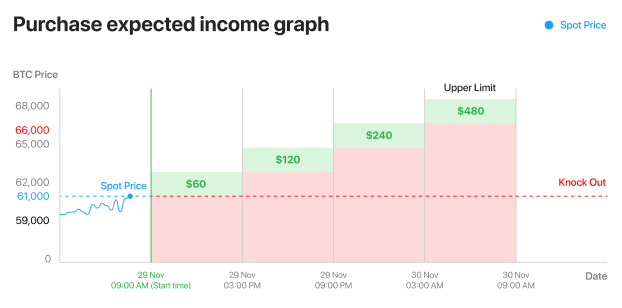
* **Tiered Option:** In essence this product is a Call-Option, which rewards the buyer according to how many tiers he can climb without falling down. The tiers in this case are different price levels that have to be maintained to gain accumulative rewards.
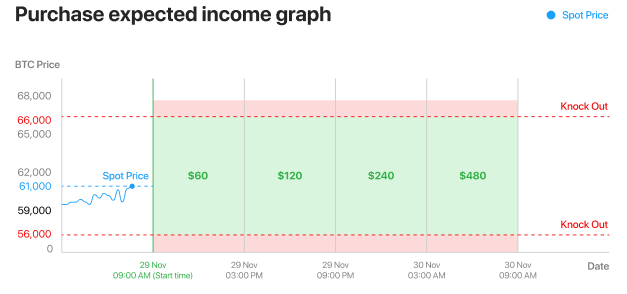
 * **Saddle Option:** This product will let you bet on the volatility of an asset. The goal is to stay within a given price interval for a given amount of time. The longer you stay on the “Saddle” the more rewards you accumulate.
## Ongoing Research
### Metaverse
With the recent uptrend of virtual worlds, the **Metaverse**, we made it our task to dive in to this topic and explore the possibilities for Antimatter. We figured that building a **Financial Center** in the Metaverse can help promote the whole Antimatter Ecosystem. Especially **Nonfungible Finance** can be facilitated well through an open Metaverse, e.g. the display of your **NFT Indexes**.
### Order Book Model
We are still in the process of researching cross-margin perpetuals with an order book model. An order book model makes it easier to onboard traditional market makers and institutions.
**Accompany us on our journey, we keep building!**
# Community & Resources
### Get involved
**Website**: [antimatter.finance](https://antimatter.finance/)
**Discord**: [Antimatter DAO](https://discord.gg/P8DHHpdJTe)
**Medium**: [antimatterdefi.medium](https://antimatterdefi.medium.com/)
**Telegram (group)**: [t.me/antimatterchat](https://t.me/antimatterchat)
**Telegram (announcements)**: [t.me/antimatterdefi](https://t.me/antimatterdefi)
**Twitter**: [twitter.com/antimatterdefi](https://twitter.com/antimatterdefi)
**YouTube**: [youtube.com/antimatterdefi](https://www.youtube.com/channel/UCyVKvWSWcW-UuuHk9l49Jfg)
**GitHub:**[ github.com/antimatter-finance](https://github.com/antimatter-finance)
# Marketing Material
You are welcome to use our logos and branding material if you need them for marketing purposes.
## **Antimatter**

{% file src="/files/37lgy7F6ZvLyfJDlfFRd" %}
**Antimatter Logo Small**
{% endfile %}
{% file src="/files/ERJXubKTZGC0PFXRtnOp" %}
**Antimatter Logo Big**
{% endfile %}
## MATTER Logo

{% file src="/files/MVxX5qFqjYTXR3Xsg6v8" %}
**Antimatter Small**
{% endfile %}
{% file src="/files/9qWbM0kwwM4EIfMrqFUb" %}
**Antimatter Big**
{% endfile %}
# Educational Infographics


# Challenges & Solutions
Options derivatives are highly complex financial products, which are difficult to use and have high barriers to entry. Options derivatives often deter many users. Therefore, we are introducing simplified derivatives products to serve users more conveniently. Meanwhile, Antimatter is facing a real challenge of a plain product structure and the lack of real users. So we plan to develop more accessible products based on the original derivatives ecosystem, in order to find new growth room.
Hence, we decided to launch Antimatter's Dual Investment product, which is a decentralized non-principal protected structured product with enhanced yield, backed by options. The product has a "market-neutral, returns guaranteed" feature, where the yield is clear and fixed at the time of purchase, while the settlement currency is uncertain. At maturity, the settlement currency depends on the outcome of the settlement price at maturity compared to the strike price.
Meanwhile, Antimatter's Bull & Bear Tokens product was designed as a Uniswap for options and derivatives with ease-of-use and improved user experience, as well as an innovative way that abandons the use of oracles to secure the system and maintain systematic independence. Instead, arbitrage activities act as “oracles” in Antimatter to make sure the price of call and put tokens follow the trend of market price movement.
Another product of Antimatter is Financial NFT. Many discussions in the NFT space have been revolving around fine arts and music, making us nearly look over the bigger, even more exciting use cases of this technology: financial NFTs. Antimatter turns NFTs into vehicles and containers of assets to store them with different locking and releasing mechanisms, as well as to facilitate various financial activities.
# Dual Investment
{% embed url="" %}
Antimatter Dual Investment - User Guide
{% endembed %}
## **Product Positioning (what)**
Antimatter Dual Investment is an advanced options derivative based on a decentralised protocol. The product has a "market-neutral, returns guaranteed" feature, where the yield is clear and fixed at the time of purchase, while the settlement currency is uncertain. At maturity, the settlement currency depends on the outcome of the settlement price at maturity compared to the strike price.
## **Background (why)**
Options derivatives are highly complex financial products, which are difficult to use and have high barriers to entry. Options derivatives often deter many users. Therefore, we are considering the introduction of simplified derivatives products to serve users more conveniently. Meanwhile, Antimatter is facing a real challenge of a plain product structure and the lack of real users. So we plan to develop more accessible products based on the original derivatives ecosystem, in order to find new growth room.
## **Business Advantages**
1. First-mover advantage of 'DeFi+Dual Investment';
2. Easy and straightforward to operate;
3. Stable & higher yields;
4. Returns guaranteed regardless of how the market goes (within a range of volatility);
5. Flexible maturity.
## **Target User Groups**
### 1. Hodlers in a fluctuating market
For example, if the whole cryptocurrency market is fluctuating, investors can purchase dual currency products with the right maturity to gain returns, as long as the price fluctuates within the relative fluctuation range of the "up and down threshold" before the maturity, they will gain higher income regardless of whether they end up settling in BTC or USDT. This is especially true for crypto hodlers and those who are not involved in derivatives trading such as contracts. As the volatile market does not allow for further gains, a dual currency product is a good option.
### 2. Falling markets: Dip buyers
For some experienced investors, they may have a prediction on the future of the market. For example, if you expect the cryptocurrency market to be in a downtrend for the next period of time and you are unable to accurately determine where the bottom is, but you expect the price to rise back in the future, you may be able to buy the dip with a Dual Investment. If you buy a coin-M Dual Invest product when the price is falling, you will not only get yields at settlement, but also more Bitcoins, as the BTC price is significantly lower than the strike price at maturity, and your coins will continue to increase in value when the price bottoms out and rises.
### 3. Rising market: Users who take profit
Similarly, if an investor predicts that the cryptocurrency market will be upward in the near future, and cannot accurately predict where the peak will be, but expects a further pullback in the future, they can also perform a take profit action through a Dual Investment. If you buy a USD-M dual invest product when the cryptocurrency price rises, and the BTC price is significantly higher than the strike price on the maturity date, you will be able to take profit at the 'upper threshold' plus the product yields at settlement. Not only will you have yields, but you will also gain more bitcoins. Meanwhile, your Bitcoin holdings will increase in value when the market rises again.
## **Main Competitors**
### 1. Binance
Strength: Safe and stable, with a more complete mechanism and a wide variety of products.

### 2. Bybit
Strength: Adopts the spot price of Uniswap V3, hence involves a certain degree of DeFi attributes.

# Rules
## Deposit and Withdrawal
Users need to first deposit from their wallet to the trading account (smart contract) on the platform in order to start dual investing.

## **Product Types**
There are two types of Dual Investment financial products: "**Upward Exercise**" and "**Downward Exercise**".
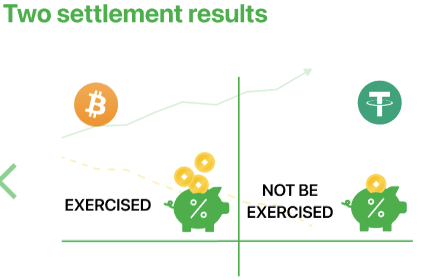
(1) **Upward Exercise**: If the Settlement Price is higher than the Strike Price, then the product will be "exercised".
* Settlement Price **≥** Strike Price, then exercised;
* Settlement Price **<** Strike Price, then it will not be exercised.
(2) **Downward Exercise**: If the Settlement Price is below the strike price, then the product will be "exercised".
* Settlement Price **≤** Strike Price, then exercised;
* Settlement Price **>** Strike Price, then it will not be exercised.
Regardless of the Underlying Asset, if the product is not exercised, the subscriber will receive a return on their investment in the form of the currency they invested. If the product is exercised at Delivery Date, the subscriber will receive a return on the investment in the form of the alternative currency.
## Settlement and Settlement Price
Each subscription has a specified Delivery Date. The average Spot Price of the last 30 minutes before 16:00 (UTC+8) on the Delivery Date will be used as the Settlement Price.
\
The Spot Price is sourced from ChainLink.
## **Yield Calculation**
1\. When a product is "exercised", the subscription amount and yields will be swapped at the strike price in the alternative currency.
**Upward Exercise:** Yields = (Subscription Amount \* Strike Price) \* \[1 + (APY % \* Period (days) / 365)]
**Downward Exercise:** Yields = (Subscription Amount / Strike Price) \* \[1 + (APY % \* Period (Days) / 365)]
2\. When a subscription is "unexercised", the subscription amount and yields will not be transferred into the alternative currency and the user will receive the currency they invested.
Yields = Subscription Amount \* \[1 + (APY% \* Period (days) / 365)]
Yields will be automatically credited to the user's account within 24 hours of settlement.
## **APY**
APY = Return Ratio / (Delivery Date - Purchase Date) \* 365\*100%
APY is constantly changing and is obtained in real time, depending on the strike price, the remaining time to delivery date and the volatility of the market price. For example, the lower the strike price, the more volatile the market price, as well as the higher the APY.
When a user successfully subscribes to a Dual Investment, it means that the APY at the time of placing the order is settled and it will not change until the delivery date.
## **Subscription and Redemption**
1. After a successful subscription, the subscription cannot be withdrawn.
2. Redemption in advance is not supported for the time being and users can only receive returns after the delivery date.
## **Product Principles**
There are two types of ordinary options: call options and put options. The buyer of a call option purchases the right to buy an asset from the seller at a certain time. The buyer of a put option purchases the right to to sell the asset to the seller at a certain time.
For the buyer and seller of an option, the benefits and risks of buying and selling options are not symmetrical. In the case of a call option, for example, the horizontal axis (S) is the price of the underlying asset, the vertical axis (π) is the resulting gain or loss, C is the margin of the call option, and K represents the strike price of the option. Regardless of how the price changes, the option seller will certainly receive the margin (C), but this is the maximum gain the seller can receive. If the price rises too much (S>K+C), the seller will bear a loss, which corresponds to what is known in the market as long-tail risk.

In essence, a user buying a Dual Investment is actually selling an option to the platform.
The ROI of a Dual Investment is calculated by the system in real time based on market movements. However, after the user buys Dual Investment, the yield is settled and will not change. This part of the amount is equivalent to the margin (C) that the user receives for selling the option.
Subsequently, the price of Bitcoin / USDT will fluctuate. At settlement, if the Bitcoin price (settlement price, i.e. S) is higher than the strike price (K), it will be settled in USDT. This is equivalent to a call option where the buyer chooses to exercise the option and the seller sells their BTC to get USDT (similar to getting cash in an option).
However, there are still differences between Dual Investment and regular options. Selling a regular option does not require any deposit. But for Dual Investment, users are required to deposit BTC or USDT in advance. This "deposit + option" model is actually closer to what is known in traditional finance as "Short Straddle Options".
**Therefore, by buying Dual Investment, the user is actually selling a call option and a put option with the same expiry date and same amount to the platform.**

As investors can make a profit in both scenarios where the settlement price is above or below the strike price, this strategy is known as straddling.
# On-chain Configurations
## Investment Targets / Underlying Assets
At the beginning of the product launch, Antimatter will list two mainstream assets as the underlying assets: BTC and ETH (more assets to be added to the list gradually).
1\. **Upward Exercise**
Deposit Currency - **BTC, ETH**
Alternate Currencies - **USDT**
2\. **Downward Exercise**
Deposit Currency - **USDT**
Alternate Currencies - **BTC, ETH**
## **Strike Price**
1. The strike price of each financial product is predetermined, while APY continues to fluctuate;
2. How to determine the strike price:
* **Upward Exercise** - Strike Price = Current Price \* 105%, rounded to thousands (E.g. $51,000). The strike price would be $52,000, $53,000, and $54,000.
* **Downward Exercise** - Strike Price = Current Price \* 95%, rounded to thousands (E.g. $51,000). The strike price would be $50,000, $49,000, and $48,000.
## **Settlement Period**
1. Antimatter supports three periods, one day, one week or two weeks.
2. When a one-week period ends, the remaining period is a one-week INVEST, at which point the contract automatically creates a new two-week INVEST (the exercise price rule is as described above).
## **Min. & Max. Limit of Single Investment**
It is supported for users to configure the Min. and Max. deposit limit of single investment.
## **Total Allocation**
Each investment product has a total allocation (e.g. 100 BTC) and new orders will be suspended when all allocation is sold out (the product status changes to \[closed] and new products are automatically incremented).
# Risk Control
The maximum return is achieved when the settlement price at the time of delivery is exactly the strike price. When the direction of market volatility is not yet clear, Dual Investment can guarantee profits regardless of how the market fluctuates within a certain range of price changes. However, when the market price deviates significantly from the strike price, the purchase of Dual Investment can also result in losses.
If the cryptocurrency price moves far beyond the investor's expectations, or the market moves unilaterally against expectations during the period of the investment, and exceeds the threshold, the greater the volatility, the greater the losses the investor may face.
Therefore, risk controls are highly recommended for users and the platform.
1. When the difference between the strike price and the spot reference price is small (less than or equal to 1%), Antimatter will suspend new subscriptions (the status of the financial product will be changed to \[Closed] and new products will be automatically incremented).
*For example, in BTC’s Upward Exercise, the lowest strike price is $58000, while the current spot reference price is 57898. The price difference is less than 1%, so the dual investment with a strike price of 58000 is suspended and not shown in the list. At this point in the INVEST list, there are still INVESTs with strike prices of 59000 and 60000, and a new INVEST with strike price of 61000 is automatically incremented into the list.*
2\. Risk statement notification/risk assessment are published to ensure that the users are clear that this is a non-principal-protected financial product with high yield .
3\. Real-time adjustment of APY is executed following market price fluctuations to control the platform's cost.
4\. A limit of a single subscription is required.
5\. The spot reference price is taken from the median of the reported prices of multiple master nodes of the Oracle machine Chainlink, to ensure the fairness of the price.
# Terminology & Calculations

# Recurring Strategy
Recurring Strategy is similar to an **DeFi Option Vault (DOV)** following the **Set-and-Forget** principle. Current available strategies are based on Dual Investment products. Recurring Strategy has weekly cycles that can be cancelled before the next cycle starts.
## **Management Strategies**
We offer two strategies for investors with BTC as underlying asset: BTC Covered Call & BTC Put Selling. The strategy algorithmically selects the optimal Strike Price for the BTC call/put options.
**BTC Covered Call**
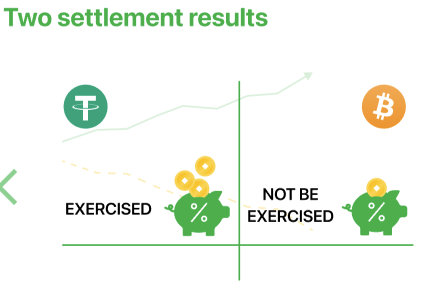
In this strategy, the deposited funds are essentially used to subscribe to an upward exercise product. This way the strategy earns yield by running a **Covered Call** ([What is a covered call?](https://www.investopedia.com/terms/c/coveredcall.asp)) that automatically covers BTC on a weekly basis. Earnings are automatically reinvested into the strategy of the settlement currency, effectively **compounding** the returns. The deposit currency is **BTC**.
**BTC Put Selling**
In this strategy, the deposited funds are used to subscribe to an downward exercise product. This way the strategy earns by running **Put Selling** ([What is put selling?](https://www.investopedia.com/terms/m/marriedput.asp)) that automatically protects BTC on a weekly basis. Earnings are automatically reinvested into the strategy of the settlement currency, effectively **compounding** the returns. The deposit currency in this case is **USDT**.
## Strike Selection and Expiry
The Strike Price is selected similarly to Dual Investment products:
* **Covered Call Strategy** - Strike Price = Current Price \* 105%, rounded to thousands (E.g. $51,000). The strike price would be $52,000, $53,000, and $54,000.
* **Put Selling Strategy** - Strike Price = Current Price \* 95%, rounded to thousands (E.g. $51,000). The strike price would be $50,000, $49,000, and $48,000.
The initial Strategy will run for 7 days, meaning that Strike Price is adjusted every week on Friday to minimize the risk of expiring *in the money*. This also allows for compounding your returns automatically
## Important Mechanics
For a clear understanding it is very important to note that the strategy **can** change **weekly** depending on the outcome of the product. In case the option is exercised, the settlement currency is different from the deposited currency and therefore in the next cycle the strategy is changed to Covered Call or Put Selling respectively.
In case you don’t want to reinvest your funds if the option gets exercised, you are able to redeem your funds before the next cycle starts. This way Recurring Strategy basically still can be used as if you were running only one strategy.
## **Difference to Competition**
Competitors like Ribbon Finance mainly run vaults with one strategy, Covered Call or Put Selling. While those kind of vaults work well when market conditions are clear, they are also vunerable to sudden market shifts.
Antimatter’s Recurring Strategy is essentially one big fund manager which simultaneously runs those two strategies. Which strategy is executed depends on the performance of BTC. The user can choose a starting point for his investment strategy: Deposit BTC for a Covered Call strategy or deposit USDT for a Put Selling strategy.
For a clear understanding it is very important to note that the strategy **can** change **weekly** depending on the outcome of the product. In case the option is exercised, the settlement currency is different from the deposited currency and therefore in the next cycle the strategy is changed to Covered Call or Put Selling respectively.
In case you don’t want to reinvest your funds if the option gets exercised, you are able to redeem your funds before the next cycle starts. This way Recurring Strategy basically still can be used as if you were running only one strategy.
# DeFi Option Vault - DOV
## What are DeFi Option Vaults?
DeFi Option Vaults (DOV) are automated vaults running with a preset options strategy. The strategy determines whether a put or call option is sold. Yield is earned by collecting premiums that accrue when the option expires 'out-of-the-money'.
Before DOVs, option strategies were only available to accredited investors through over-the-counter (OTC) trading or by self-execution on option exchanges like Deribit.
#### Why make it a shared vault?
The automation is facilitated through a smart-contract on the blockchain. Users can deposit their assets into the smart-contract/vault and it will automatically start earning on a weekly basis. Apart from the obvious advantage of automatization, another advantage is the saving of gas. Once the assets are deposited, there is no further action required from the user, until he wants to redeem his returns. Transactions from all users of the vault are pooled together, saving a lot of gasfees.
## Strike Price and Delivery Date
The best result for a vault is when the sold options do not get exercised and expire worthless ('out-of-the-money'), but the premium from selling the options is still collected. To reduce the risk of the option getting exercised we can vary two parameters: **Strike Price and Delivery Date**
**Strike Price:**
The further away the Strike Price is from the Spot Price at the start of a cycle, the less likely it is that an option is exercised. This is logical, since large price movements are generally less likely.
**Delivery Date:**
The longer the cycle of the vault, the harder it gets to predict the price action of the underlying asset. For example it is harder to say where BTC will be in a week, compared to a year.
Our first vaults will run a weekly cycle with Strike Prices XX% away from Spot Price.
# Mechanism
## Process Architecture

This sequence diagram illustrates the vaults process. The manager has a priveleged role in the sense that he creates an oToken with Strike Price and Delivery Date of the vault. Users can deposit their assets that will act as collateral. The vault closes and the weekly cycle starts.
On Friday, the manager will use all the funds of the vault as collateral to mint the standard ERC-20 option contract token (oToken) on-chain through Opyn’s factory contract, and sell it directly to market makers.
The option expires after one week. On expiry the price is determined through Chainlink’s Data Feed, and the option premium + funds are withdrawable for the user. Funds can be left inside the vault and in this case will automatically be used for the next cycle.
# Weekly Sharkfin
## What is Antimatter Sharkfin?
A principal-protected product, where users subscribe using the required currency and earn varying yields based on a specified price range of the underlying asset. The product runs on a weekly basis and redemption is only possible at maturity. Namely, sharkfin product has two parameters that change every week: Price range and APR range. They are adjusted to provide an attractive APR, but also low risk. In simpler words: you deposit a currency and earn yield on it, if the asset stays in a price range you get more %APR. If it doesn’t, you get less %APR.
## Product Positioning
Sharkfin options are already an established structured product on various underlying assets. Antimatter is determined to bring traditional derivatives on-chain, while simultaneously innovating the space. Antimatter Sharkfin is the decentralized version of the traditional sharkfin product and will be starting out with $BTC and $ETH as first underlying assets. Users are provided with attractive APR rates, while keeping a low risk profile and keeping their principal protected.
# Mechanism
## Rules of Return
A sharkfin product has two parameters that change every week: Price range and APR range. They are adjusted to provide an attractive APR, but also low risk.
**Price range:** *lowerBarrier($)*-*upperBarrier($)*, **APR range:** *lowerApr(%)-upperApr(%)*
At maturity there are two outcomes:
### **1.** Asset price was **always** in the price range:
Annualised Percentage Return (APR) =
*lowerApr*(%) **+** (settlement price **-** *lowerBarrier*)/(*upperBarrier* **–** *lowerBarrier*)\* (*upperApr*(%) **-** *lowerApr*(%))
*return = principal \* APR/365 \* 7 (investment term)*
### **2.** Asset price was atleast once below *lowerBarrier* or above *upperBarrier*:
*return = principal \* lowerApr/365 \* 7 (investment term)*
So obviously the objective is to stay within the price range, the higher the settlement price the higher the APR. Nevertheless, you earn a minimum APR even with the second outcome.
## Risks
Antimatter Sharkfin is principal protected, meaning that you are guaranteed a minimum return equal or more than the initial investment. There is no such concept of liquidation or margin calls. As the money is handled through a smart contract, usual smart contract risks apply. Furthermore, this product is released in Beta.
# Introduction
# Options Basics
On this page you will find educational information about options and video tutorials for mastering options trading fast. Enjoy fixed prices and unlimited upside of the options contracts.
## What are Options?
An option is a contract **giving the buyer the right, but not the obligation**, to buy (in the case of a call option contract) or sell (in the case of a put option contract) the underlying asset **at a specific price on or before a certain date**. Traders can use on-chain options for speculation or to hedge their positions. Options are known as **derivatives** because they derive their value from an underlying asset.
{% embed url="" %}
## Video: Call and Put Options
{% embed url="" %}
## What is a Call Option?
A **call option** is an option contract giving the owner the right, but not the obligation, **to buy** a specified amount of an underlying asset at a specified price within a certain time. The pre-determined price the call option buyer can buy at is called the **strike price**.
For example, a single call option contract may give a holder the right to buy 1 ETH at $200 up until the expiry date in four weeks. There are many expiration dates and strike prices for traders to choose from.
* **Potential Profit:** Unlimited as the level of the underlying asset increases
* **Potential Loss:** Limited to premium paid for a call option contract

## Example: Buying a Call Option
The price of a call option is called the **premium**. It is the price paid for the rights that the call option provides. If at expiry the underlying asset is below the strike price, **the call buyer loses the premium paid. This is the maximum loss**.
If the underlying's price is above the strike price at expiry, **the profit is the current asset price minus the strike price and the premium**.
For example, if ETH is trading at $200 at expiry, the strike price is $150, and the option costs the buyer $10, the profit is $200 - ($150 + $10) = $40. If at expiry ETH is below $150, then the option buyer loses $10 for each contract they bought.
## What is a Put Option?
A put is an option contract giving the owner the right, but not the obligation, **to sell** a specified amount of an underlying asset at a specified price within a certain time. The pre-determined price the put option buyer can sell at is called the **strike price**.
* **Potential Profit:** Substantial and increases as the level of the underlying asset decreases to zero
* **Potential Loss:** Limited to premium paid for a put option contract

## Example: Buying a Put Option
The price of a put option is called the **premium**. It is the price paid for the rights that the put option provides. If at expiry the underlying asset is above the strike price, **the put buyer loses the premium paid. This is the maximum loss.**
If the underlying's price is below the strike price at expiry, **the profit is the strike price minus the current asset price and the premium**.
For example, if ETH is trading at $150 at expiry, the strike price is $200, and the option costs the buyer $10, the profit is $200 - ($150 + $10) = $40. If at expiry ETH is above $200, then the option buyer loses $10 for each contract they bought.
## What is a Strike Price?
A strike price is the set price at which an option contract can be bought (call option) or sold (put option) when it is exercised. **For call options**, the strike price is where the asset **can be bought** by the option holder; **for put options**, the strike price is the price at which the asset **can be sold**. \
\
The strike price is a key variable of call and put options. For example, the buyer of an ETH call option would have the right, but not the obligation, to buy that ETH in the future at the strike price. Similarly, the buyer of an ETH put option would have the right, but not the obligation, to sell that ETH in the future at the strike price.
## What is an Expiration Date?
An expiration date in options is **the last day that options contracts are valid**. \
\
On or before this day, options contracts holders will have already decided what to do with their expiring position. Before an option expires, its owners can choose to exercise the option, close the position to realize their profit or loss, or let the contract expire worthless.\
\
The **expiration time** of an options contract is the date and time when it is rendered null and void. It is more specific than the expiration date and should not be confused with the last time to execute that option.
## What is an Option Premium?
**An option premium is the price of an option contract**. It is thus the income received by the seller (writer) of an option contract. In-the-money option premiums are composed of two factors: **intrinsic and extrinsic value**. Out-of-the-money options premiums consist **solely of extrinsic value**.
The main factors affecting an option's price are **the underlying assetss' price, moneyness, useful life of the option and implied volatility**. As the price of the underlying asset changes, the option premium changes. As the underlying asset's price increases, the premium of a call option increases, but the premium of a put option decreases. As the underlying asset's price decreases, the premium of a put option increases, and the opposite is true for call options.
The moneyness affects the option's premium because it indicates how far away the underlying asset price is from the specified strike price. As an option becomes further in-the-money, the option's premium normally inc*r*eases. Conversely, the option premium decreases as the option becomes further out-of-the-money. For example, as an option becomes further out-of-the-money, the option premium loses intrinsic value, and the value stems primarily from the time value.
## Example: Selling a Call Option
A trader would choose to sell a call option if their outlook on a specific asset was that it was going to fall, as opposed to the bullish outlook of a call buyer. \
\
**The buyer of a call option pays a premium to the writer for the right to buy the underlying asset at an agreed upon price in the event that the price of the asset is above the strike price.** In this case, the option seller would get to keep the premium if the price closed below the strike price.
For example, the seller of ETH call option with a strike price of $200 **will receive a premium of $10 from the ETH call buyer**. In the event that the market price of ETH drops below $200, the buyer will not exercise the call option and the seller's payoff will be $10. If ETH's market price rises above $200, however, the call seller is obligated to sell ETH to the call buyer at the lower strike price, since it is likely that the call buyer will exercise their option to buy ETH at $200.
## Example: Selling a Put Option
A trader would choose to sell a put option if their outlook on the underlying asset was that it was going to rise, as opposed to a put buyer whose outlook is bearish. \
\
**The buyer of a put option pays a premium to the writer for the right to sell the shares at an agreed upon price in the event that the price heads lower.** If the price rises above the strike price, the buyer would not exercise the put option since it would be more profitable to sell at the higher price on the market.
For example, the seller of an ETH put option with a strike price of $200 **will receive a $10 premium fee from an ETH put buyer**. If ETH's market price is higher than the strike price of $200 by an expiration date, the put buyer will choose not to exercise their right to sell at $200 since they can sell at a higher price on the market. The buyer's maximum loss is, therefore, the premium paid of $10, which is the seller's payoff. If the market price falls below the strike price, the put seller is obligated to buy ETH from the put buyer at the higher strike price since the put buyer will exercise their right to sell at $200.
## 10 Options Strategies To Know
{% embed url="" %}
## Video: Options Trading Math
{% embed url="" %}
"Options Trading Math 101" by Options Alpha:
{% endembed %}
## Video: Path To Consistent Income
{% embed url="" %}
# Antimatter Features
Antimatter perpetual options have the following features:
✔ **Non-custodial** 24/7 global options trading\
✔ **Perpetual Options**\
✔ **Permissionless** for everyone to issue options\
✔ **No liquidation risk** among all Call / Put options\
✔ **No funding fees**\
✔ **No external oracle**\
✔ **Verified on-chain settlement** of each option contract\
✔ **Underlying assets fully backed** for Call / Put options\
✔ **Exercise at any moment** during the period of holding a contract
# Comparative analysis
## Antimatter
We aim to decide whether a particular cryptocurrency is bullish or bearish by using a financial derivative: perpetual options. We achieve this by tokenizing perpetual options, so that investor can forge and trade these tokens. There are two token types: call token and put token, which correspond to call and put perpetual options. To understand how they work, we have a price interval that contains the current price of a certain cryptocurrency and we anticipate that the price of this currency will change within this interval. If we work with ETH and in case that the price varies within the interval, one can generate antimatter token(call and(or) put) by providing two types of underlying assets, such as ETH and USDT. Typically, one needs to provide more ETH to generate a call token and more USDT to generate a put token. The cost of producing tokens will vary in order to stabilize the platform.
## Perpetual Protocol
Perpetual Protocol is a decentralized perpetual contract protocol for every asset, realized by a Virtual Automated Market Maker. Perpetual protocol enables traders trade with up to 16x leverage. It enables traders to speculate on a type of asset using another type of asset. The algorithm is $$AB=k,B=An$$, where $$A,B$$ are volume of two types of assets, $$n$$ is the value satisfying "$$B$$ is traded at $$n$$ times $$A$$(Or the price of $$B$$in terms of $$A$$)", and $$k$$ is an invariant. The trader needs to deposit type a asset in order to speculate type b asset. In math, If one supplies $$a\_1(-a\_1)$$, he will open long(short) position of amount $$B-\frac{k}{A+a\_1}(\frac{k}{A-a\_1}-B)$$ in type $$B$$ asset. In general perpetual protocol is a perpetual contract without expiration date.
## Shield
Shield is a decentralized risk-free perpetual contract built on ETH, such that traders can speculate. Unlike normal contract trading, shield uses pre-paid funding fee to let trader open position. That is, the trader pre-pays certain amount of asset, which will be shown in and used as his funding fee balance. The balance will decrease each day as the platform takes funding fee. When the balance is zero, the trader either needs to closed his position or to deposit more collateral. For a single position, the risk is finite: the amount he pre-pays. The profit is calculated by gains in speculation-transaction fee-funding fee-transaction fee.
## Futureswap
Futureswap is a protocol that traders can speculate one type of crypto asset using stable coin with up to 10x leverage. The liquidity provider will earn FST(Futureswap token) as an incentive to provide liquidity. The trading rules are standard, yet to protect the platform, one needs to pay more significantly higher fees if his direction is in favor of the majority. Typically, when the long and short sides are in balance, the fee is $$0.03%$$ of the trading amount. However, if the long side is significantly more than the short side, one needs to pay as much as ten times trading fee, vice versa. Higher fee will decrease the potential profit, thus decrease the incentive to play in a particular direction, thus, stabilizing the platform.
## Hegic
Hegic Options allows trader to trade options based on ETH and WBTC. There is no trading fee or gas fees. The traders can hold options contracts up to 90 days. 30 minutes before options expire, they will be exercised automatically. The size of options will decrease after options trading volume reaches certain amount. For example, the underlying asset of an option contract is 10 ETH, but after the cumulative volume reaches certain amount, traders can trade a contract worth 1 ETH. In general, this product simplies the processes of trading and gives trader some benefits with respect to funding fees.
## Sam's Innovation
Everlasting Options works exactly the same as perpetual futures with only one difference that the underlying asset is options. Accordingly the formula of funding fee is changed to "short-mark". For example, Consider the $3000 strike everlasting ETH put with funding paid once daily. If ETH is currently trading at $2900, the current payoff of the put is $3000 – $2900 = $100. If the everlasting put is trading for $150 the instant before funding is paid, then the longs would have to pay the shorts mark – payoff = $150 – $100 = $50 per day.
## Opyn V2
Opyn V2, allows anyone to buy, sell, and create options on any ERC20 asset
Among the six different protocols, there are some similarities and differences. Perpetual protocol and shield are perpetual contracts using different algorithms. Perpetual protocol uses a product as an invariance to stabilize the system, while shield limit the amount of money a trader needs to pay in order to trade, thus, limiting the maximum loss. Futureswap has similar features to Antimatter, because it has dynamic fees to protect the platform. On the other hand, the dynamic counterpart in Antimatter is the cost to produce tokens. The difference is that Antimatter has price floor and price ceiling. It preserves the feature of a straddle(options), but Futureswap does not. Hegic Options is not a perpetual option. one can only hold it up to 90 days. Therefore, the mechanisms is much different to Antimatter. Everlasting Options is perpetual future for options. Since options has many strikes, Everlasting Options has many ramifications. In essence, it s futures rather than options. The big difference is that Antimatter does not rely on oracles, while the other six do. Thus, Antimatter reduces the possibility that one takes advantage of time lag.
# Technical Whitepaper
{% embed url="" %}
# Structure


# Option Token Symbol System
Antimatter uses a standardized systematic way to represent the option product, call token, and the put token.
## General AntiMatter Option Product Notation
An AntiMatter Option product has three variables to consider:
* Asset
* Price Floor
* Price Ceiling
Notation is as follows: **ASSET(Price Floor $ Price Ceiling)**
{% hint style="info" %}
**The ETH OPTION ranging from $1000 to $3000 will be represented as ETH(1000$3000)**
{% endhint %}
## Call Option Token Notation
A Call option token has three variables to consider:
* Call (+) symbol
* Asset
* Price Floor
Notation for a Call token is as follows: **+ ASSET($ Price Floor)**
{% hint style="info" %}
**The ETH call option with the price floor $1000 will be represented as + ETH($1000)**
{% endhint %}
## Put Option Token Notation
A Put option token has three variables to consider:
* Put ( - ) Symbol
* Asset
* Price Ceiling
Notation for a put token is as follows: **- ASSET($ Price Ceiling)**
{% hint style="info" %}
**The ETH put option with the price ceiling of $3000 will be represented as -ETH($3000)**
{% endhint %}
# Mechanism
It is a financial tool that helps investor decide whether a cryptocurrency is bullish or bearish.
We aim to decide whether a particular cryptocurrency is bullish or bearish by using a financial derivative: perpetual options. We achieve this by tokenize perpetual options, so that investors can forge and trade these tokens. One can judge based on two facts: the market price of the asset and the cost of generating tokens.
# Price Equilibrium and Arbitrage
Given a price range $$\[F,C]$$ within which the price of the specific cryptocurrency varies, where $$F$$ is the strike price for call and $$C$$ is the strike price for put. Let $$c\in \[F,C]$$ be the market price of the cryptocurrency on the platform. Thus $$c-F$$ is the intrinsic value of a call token, while $$C-c$$ is the intrinsic value of a put token. Let $$x,y$$ be the amount of call and put token respectively, and $$z$$ be the total reserved value. The total reserved value is all the asset collected that are used to generate Antimatter tokens. If call and put tokens increase at the same ratio, the price should not change. We aim to build a model that $$z$$ is a function of $$x$$ and $$y$$, $$z=f(x,y)$$, such that $$kf(x,y)=f(kx,ky)$$ With this equation, we are able to define the price of each token: $$\frac{\partial z}{\partial x}, \frac{\partial z}{\partial y}$$ When the volumes of both tokens are equal, it is expected that the prices of both tokens are equal(In reality, the price of call tokens might be higher, because it has more upside potential). When the volume of call tokens far exceeds the volume of put tokens, it is expected that the price of put token approaches $$0$$. When the volume of put tokens far exceeds the volume of call tokens, it is expected that the price of put token approaches $$C-F$$. The behavior of call token is wilder but in the same way. One note is that the price of both tokens depends on the ratio of volume of both tokens, rather than the difference between them.
For example, we work with ETH and USDT. The price of ETH in terms of USDT varies within the interval $$\[1000,4000]$$. Here $$1000$$ is the strike price of call, and $$4000$$ is the strike price of put. If the ratio between call token and put token generated is $6:4$, it is expected that the market price is $$3500$$ In this case, the cost to generate a call token is about $$6000$$ and the cost to generate a put token is about $$240$$. When there is a difference between the market price and market price of ETH, one can buy and sell call or put token in two market to make profit.
The actual model goes as follows. Let $$z=\frac{(C-F)y^2}{\sqrt{x^2+y^2}}+e\cdot\frac{C-F}{C}\frac{x^2}{\sqrt{x^2+y^2}}$$ where $$e$$ is the price of ETH. This expression ensures that $$\frac{\partial z}{\partial x},\frac{\partial z}{\partial y}\geq0$$. This model works well with prices of tokens because of positive definiteness. Because the lowest possible price of ETH is $$0$$ and the highest price of ETH is infinity, the price of call token will be appreciated to a greater extend, if the price moves in the right direction. The prices of both tokens remain in the interval $$\[0,C-F]$$ for current version.
Starting from $$z=f(x,y)$$, such that $$kf(x,y)=f(kx,ky)$$, we have the equivalent following $$xf\_x+yf\_y=f$$. Let $$r=\sqrt{x^2+y^2},\theta=\tan^{-1}(\frac{y}{x})\in (0,\frac{\pi}{2})$$. Also, $$x=r\cos\theta,y=r\sin\theta$$. We further transform:\
$$xf\_x+yf\_y=f\equiv\frac{x}{r}f\_x+\frac{y}{r}f\_y=\frac{f}{r}$$. By chain rule, we have $$\frac{\partial f}{\partial r}=\frac{f}{r}$$ Therefore $$f=A(\theta)r$$ for some function $$A$$(This is true for any function of $$\theta$$). Now we put these aside and consider the second question. The idea is that because $$(C-F)f=U+Ee$$, we may find $$U,E$$ first and then sum them up because of homogeneity. We need $$\frac{\partial U}{\partial x}<0,\frac{\partial U}{\partial y}>0,\frac{\partial E}{\partial x}>0,\frac{\partial E}{\partial y}<0$$. It worth checking that $$U=y\cdot(\frac{y}{\sqrt{x^2+y^2}})^i,E=x\cdot(\frac{x}{\sqrt{x^2+y^2}})^i$$ satisfy the above inequalities. By homogeneity conditions, it turns out summing through index $$i$$ does no harm anything (although it turns out that the summation is redundant). We relate $$U$$ and $$E$$ with $$\theta$$ by $$\sin\theta=\frac{y}{\sqrt{x^2+y^2}},\cos\theta\frac{x}{\sqrt{x^2+y^2}}$$. Then by choice of $$A$$, we can obtain that $$z=f(x,y)=x\cdot e\cdot\sum\_{i=1}^\infty e\_i(\frac{x}{\sqrt{x^2+y^2}})^i+y\cdot\sum\_{i=1}^\infty u\_i(\frac{y}{\sqrt{x^2+y^2}})^i$$ Next, we consider why $$I$$ must be equal to $$1$$. For simplicity, we let those constants be $$1$$ Suppose $$I=2$$, then $$E=\frac{x^3}{x^2+y^2},E\_x=\frac{x^2(x^2+3y^3)}{(x^2+y^2)^2}$$. Similarly, $$U\_x=\frac{-2y^3x}{(x^2+y^2)^2}$$. If we consider $$z\_x=U\_x+eE\_x=\frac{ex^4+y^2x(3ex-2y)}{(x^2+y^2)^2}$$ and $$z\_y=U\_y+eU\_y=\frac{y^4+3x^2y^2-2ex^3y}{(x^2+y^2)^2}$$ That their numerators are different means that we need more relations on $$x$$ and $$y$$, which is implausible since $$x$$ and $$y$$ are the token volume. Thus $$k=1$$. The final thing is to take some constants that have good numerical performance and it is $$E=\frac{C-F}{C}\cdot\frac{x^2}{\sqrt{x^2+y^2}},U=(C-F)\cdot\frac{y^2}{\sqrt{x^2+y^2}}$$. $$z$$ follows directly.
# Generation and Redemption
Antimatter token is a perpetual option. There are two token types: call token and put token, which correspond to call and put perpetual options. To understand how they work, we have a price interval that contains the current price of a specific cryptocurrency and in this model we anticipate that the price of the cryptocurrency will change within this interval. If we work with ETH and USDT and in case that the price varies within the interval, one can generate antimatter token(call and(or) put) by providing two types of underlying assets, such as ETH and USDT. Typically, one needs to provide more ETH to generate a call token and more USDT to generate a put token. The redemption of tokens is simply exercising corresponding options. In essence, all call and put tokens have underlying asset backed onchain.
**Uniswap Smart Router:**\
Thank to Uniswap's Smart Router, participants are able to use any tokens through uniswap to generate and redeem call and put tokens. When a user use token A to generate a call, router will allocation A into two underlying assets following the underlying asset ratio.
# Underlying Asset
Any cryptocurrency+ any stable coin
To generate an Antimatter token, one needs to provide two types of underlying assets: one type of cryptocurrency and a stable coin. For example, ETH as the cryptocurrency and USDT as the stable coin. Generating a call token generally requires more ETH, while generating a put token requires more stable coin. The generating process only takes a second.
As usual, we have a difference between the price floor($$F$$) and price celling($$C$$), $$x,y$$ be the call and put token generated respectively. We divide the premium into two parts: stable coin $U$ and any cryptocurrency $$Ee$$, where $$E$$ is the quantity and $$e$$ is the price. Since stable coin preserves value, we may always assume that its price is $$1$$. Then, we define the following: $$U=\frac{(C-F)y^2}{\sqrt{x^2+y^2}},E=\frac{C-F}{C}\frac{x^2}{\sqrt{x^2+y^2}}$$Using a calculator, we find that $$\frac{\partial U}{\partial x}<0,\frac{\partial U}{\partial y}>0,\frac{\partial E}{\partial x}>0,\frac{\partial E}{\partial y}<0$$. This feature agrees with our expectation in that generating more call tokens requires more cryptocurrency and less stable coin, while generating put tokens requires more stable coins and less cryptocurrency. it is required because the platform must be prepared for any possible token redemption at any time.
# Leverage Ratio
In general, leverage is described under two frames.
The first one is inherent, which based exclusively on $$C$$and $$F$$. The current version(R3) is defined under the condition that $$C\leq 2F$$, resulting in that the leverage is moderate and the price of both tokens will remain in the the interval $$\[0,C-F]$$. The rate of change of token prices will be medium as price of ETH changes. Future versions will include $$4F \geq C \geq 2F$$(R4) and $$C\geq 4F$$(R5). In these cases, the price of call token will exceed $$C-F$$, meaning that when price spikes, one can make more money if he holds a call token. If the price of ETH dips, the call token price will drop in the same fashion. In the extreme case, there might be negative prices, which can be seen either as an anomaly or a perfect change to generate a token.
The dynamic leverage is related to the extend that the price differs from the strike price. If $$c$$is close to $$F$$, the call token has very high leverage. If $$c$$is close to $$C$$, the put token has very high leverage. There are two expressions(for call and put respectively) $$e\cdot\frac{E\_x}{z\_x},e\cdot\frac{E\_y}{z\_y}$$ measuring how much the option value changes corresponding to underlying value changes.
Putting two frames together, supposing that $$F=1000,C=5000,c=1100$$, call token is highly leveraged.
# Arbitrage Example
For the examples given below, which involves interaction between the value of underlying assets and current price, we work with ETH and USDT and we restrict that the price of ETH varies between $$1000$$ and $$5000$$. The examples only include call tokens. Here generating a token essentially the same as buying a token.
## Case One
Supposing that the price of ETH is $$3000$$ and the value of underlying asset is $$3500$$, one has incentive sell (redeem) a token to make profit. This is due to the market price is less than the underlying value, then selling a call token will give the profit equalling to the difference between two prices.
## Case Two
Suppose that the market price of ETH is $$$3500$$ and our indicator price is $$$3000$$. Given that the cost to produce a call token and the price of a call token in secondary market are equal, one has incentive to generate a token and sell it in the secondary market to make profit. This is due to the indicator price is less than the market price, then the intrinsic value of call token is greater than the difference between the indicator price and price floor.
Supposing that the price of ETH is $$3500$$ and the value of underlying asset is $$3000$$, one has incentive to generate a call token to make profit. This is due to the market price is higher than the underlying value, then generating it will give the profit equalling to the difference between two prices.
The investor has finite arbitraging opportunities, stablizing the the whole system as arbitraging takes place. Arbitraging strategies are exactly the opposite for put tokens.
{% hint style="info" %}
In a volatile market and ideally, the market price of ETH moves ahead of the indicator price. This creates opportunity to arbitrage. In general price of call tokens should be positively related to price of ETH and price of put token should be negatively related to price of ETH. As the our platform stabilizes itself, the lag in time creates opportunity to arbitrage.
{% endhint %}
# Slippage & Fees (full disclosure)
To sum up, there are 5 factors leading to a gap in the price of an options token upon selling and buying.
1. Transaction fee (0.5%) + Slippage (0.5%) = 1%;
2. Paying $1.5 worth of BNB can get the user $0.5 worth of BUSD. Both will charge 1% of transaction fees. Hence, transaction fee = 1.5*1% + 0.5*1% = 2%;
3. Meanwhile, BUSD will be swapped into BNB and PancakeSwap will charge 0.3% as the transaction fee;
4. Buying activities will lead to an increase in the price. In this case, Bull token will go from 465.09716 (pre-purchase) to 466.36835 (post-purchase), with a 0.2733% growth. The swap will also cause the price BNB to go up. However, its effect is limited and can be ignored;
5. Selling activity has a reverse process. Hence the price difference is twice of what we discussed above.
For instance, as of Oct. 9th, the price of one +BNB($200) token is 1.597742393051479425 BNB, and the buyer will also get 209.205337167898666200 BUSD upon purchase. Both will charge 0.5% as transaction fee on top of 0.5% of slippage. Hence the total cost comes to 1.613719816981994219 BNB. The user gets 1 +BNB($200) token and 207.113283796219679538 BUSD. PancakeSwap charges 0.3% of transaction fee when swapping these BUSD into 0.488892 BNB. This brings the cost of 1 +BNB($200) token to 1.613719816981994219 BNB - 0.488892 BNB = 1.124827816981994219 BNB. Please note that we didn’t take the price increase caused by buying pressure into consideration.
# Oracles
Antimatter does not relay on any oracles
Oracles play an important role in defi applications and are sources of many forms of attacks. Antimatter designs an innovative way to abandon the use of oracles to secure the system and maintain systematic independence.
In Antimatter, arbitrage activities will act as "oracles" to make sure price of call and put tokens follow the trend of market price movement of target assets.
## Why Antimatter does not rely on Oracles?
Flash loan allows investors to borrow and return significant amount of money without interest rate within one transaction block. Flash loan attack can have devastating effect to the exchange(platform). Here is an example: one can first borrow a large amount of asset A from the protocol. He swaps asset A to asset B, so that the price of asset A will decrease. He then use the swapped asset B as collateral and borrow more asset A. This could be achieved because the price of asset A has decreased. After he returned asset A, the difference in the amount is his profit. It seems profitable but it will ultimately drain the pool since the above process can happen every block. Asset A and B can be contracts too. Contract trading always includes inherent leverage, so the effect can be magnified, which is detrimental to the platform. Certainly with flash loan, one can arbitrage and wash trade, but stabilizing the platform is of more importance.
A large number of protocols uses oracle. Oracle is used to receive Defi-related data from other platforms. The use of oracle can sometimes cause trouble to the protocol. Suppose that it takes 1 second to display the price of a certain cryptocurrency. Within 1 second, the price changes and one smart trader realizes this change. He then can open position and take advantage of the pricing lag. The drawback of the delay can cause trouble in extreme volatile market. If one pumps and dumps a certain asset, the execution price will be unfavorable to other traders because of this lag. Since the decentralized exchange generally exhibits prices slower than the centralized exchange, a delay in the price display is unfavorable to contract trader. A simple example is that the trader's position may have been liquidated before he realizes the price change. Antimatter platform, however, does not rely on oracle. The pricing mechanism can stabilize itself.
# Permission-less protocol
Antimatter aims to be a permission-less protocol where everyone can design and deploy various perpetual options.
The beauty of decentralized finance is that it allows everyone to build financial products and tools in different ways. The rise of Uniswap proves that a decentralized protocol can fill a large gap of token trading and listing through smart contracts. With the foundation of spot trading being consolidated, there are needs for permission-less protocol for derivatives.
Antimatter is designed for permission-less deployment of perpetual options. Anyone can create option markets and customize their option products. To create an option market, the Antimatter protocol requires several parameters:
* Target assets (The crypto asset that you want to create option for)
* Underlying assets (The reserve assets to back the option)
* Price range ( Each option has a price range with price floor and ceiling)
{% hint style="info" %}
Example: You can create an ETH perpetual option with price range from 100 to 4000 USD.
{% endhint %}
The option market creation supports various asset types across ERC20, BEP20, HECO etc. The underly assets support basket of stable-coins such as USDT, USDC, DAI, BUSD.
The issuance of an option product comes with two tokens: call and put tokens. The call and put tokens can be used to generate, redeem, or liqudity provision to the secondary market.
It is important to reiterate that a pool/market simply comprises an autonomous smart contract deployed on the relevant blockchain network, operated directly by users calling functions on it (which allows them to interact with other users and/or pool their own selected assets in a peer-to-peer manner), and with no further control by or interaction with the original entity which had deployed the smart contract.
# Mathematics


{% embed url="" %}
# Modelling Kit
{% embed url="" %}
{% embed url="" %}
# Mathematical Model

# Introduction
A hub for research and development
Antimatter DAO is a club for derivatives fanatics and a collaborative workplace for innovative on-chain derivatives applications, with features including on-chain governance, multi-party treasury management, academic resources sharing, and new model experiments.
## Antimatter DAO Members:
**Tekin Salimi**, the general partner of Polychain Capital and a strong believer and advocate of DAO. Salimi believes that the continued use of DAOs to be of the utmost importance to the next evolution of the blockchain industry.
**Do Kwon**, the Co-founder and CEO of [Terraform Labs](https://terra.money/), the company behind the Terra Blockchain. Terra strives to use blockchain technology to develop a more efficient payment system.
**Justin Sun**, the founder of Tron foundation, an ambitious project dedicated to building the infrastructure for a truly decentralized Internet.
**Brian Lee**, partner at Alameda Research Ventures, a quantitative trading firm bringing expertise from Wall Street and Silicon Valley to provide liquidity in crypto markets worldwide.
# Governance Policies
{% hint style="info" %}
Disclaimer: The Antimatter decentralized governance system replaces the centralized party administration system with community governance, allowing protocol participants to suggest, debate, and implement changes to the protocol without relying on, or requiring, the team in any way whatsoever.
{% endhint %}
Antimatter On-chain Governance Policies:
1. All proposals are subject to a 3 to 7 days voting period. The period is set by the proposer.
* **Saddle Option:** This product will let you bet on the volatility of an asset. The goal is to stay within a given price interval for a given amount of time. The longer you stay on the “Saddle” the more rewards you accumulate.

## Ongoing Research
### Metaverse
With the recent uptrend of virtual worlds, the **Metaverse**, we made it our task to dive in to this topic and explore the possibilities for Antimatter. We figured that building a **Financial Center** in the Metaverse can help promote the whole Antimatter Ecosystem. Especially **Nonfungible Finance** can be facilitated well through an open Metaverse, e.g. the display of your **NFT Indexes**.
### Order Book Model
We are still in the process of researching cross-margin perpetuals with an order book model. An order book model makes it easier to onboard traditional market makers and institutions.
**Accompany us on our journey, we keep building!**
# Community & Resources
### Get involved
**Website**: [antimatter.finance](https://antimatter.finance/)
**Discord**: [Antimatter DAO](https://discord.gg/P8DHHpdJTe)
**Medium**: [antimatterdefi.medium](https://antimatterdefi.medium.com/)
**Telegram (group)**: [t.me/antimatterchat](https://t.me/antimatterchat)
**Telegram (announcements)**: [t.me/antimatterdefi](https://t.me/antimatterdefi)
**Twitter**: [twitter.com/antimatterdefi](https://twitter.com/antimatterdefi)
**YouTube**: [youtube.com/antimatterdefi](https://www.youtube.com/channel/UCyVKvWSWcW-UuuHk9l49Jfg)
**GitHub:**[ github.com/antimatter-finance](https://github.com/antimatter-finance)
# Marketing Material
You are welcome to use our logos and branding material if you need them for marketing purposes.
## **Antimatter**

{% file src="/files/37lgy7F6ZvLyfJDlfFRd" %}
**Antimatter Logo Small**
{% endfile %}
{% file src="/files/ERJXubKTZGC0PFXRtnOp" %}
**Antimatter Logo Big**
{% endfile %}
## MATTER Logo

{% file src="/files/MVxX5qFqjYTXR3Xsg6v8" %}
**Antimatter Small**
{% endfile %}
{% file src="/files/9qWbM0kwwM4EIfMrqFUb" %}
**Antimatter Big**
{% endfile %}
# Educational Infographics


# Challenges & Solutions
Options derivatives are highly complex financial products, which are difficult to use and have high barriers to entry. Options derivatives often deter many users. Therefore, we are introducing simplified derivatives products to serve users more conveniently. Meanwhile, Antimatter is facing a real challenge of a plain product structure and the lack of real users. So we plan to develop more accessible products based on the original derivatives ecosystem, in order to find new growth room.
Hence, we decided to launch Antimatter's Dual Investment product, which is a decentralized non-principal protected structured product with enhanced yield, backed by options. The product has a "market-neutral, returns guaranteed" feature, where the yield is clear and fixed at the time of purchase, while the settlement currency is uncertain. At maturity, the settlement currency depends on the outcome of the settlement price at maturity compared to the strike price.
Meanwhile, Antimatter's Bull & Bear Tokens product was designed as a Uniswap for options and derivatives with ease-of-use and improved user experience, as well as an innovative way that abandons the use of oracles to secure the system and maintain systematic independence. Instead, arbitrage activities act as “oracles” in Antimatter to make sure the price of call and put tokens follow the trend of market price movement.
Another product of Antimatter is Financial NFT. Many discussions in the NFT space have been revolving around fine arts and music, making us nearly look over the bigger, even more exciting use cases of this technology: financial NFTs. Antimatter turns NFTs into vehicles and containers of assets to store them with different locking and releasing mechanisms, as well as to facilitate various financial activities.
# Dual Investment
{% embed url="" %}
Antimatter Dual Investment - User Guide
{% endembed %}
## **Product Positioning (what)**
Antimatter Dual Investment is an advanced options derivative based on a decentralised protocol. The product has a "market-neutral, returns guaranteed" feature, where the yield is clear and fixed at the time of purchase, while the settlement currency is uncertain. At maturity, the settlement currency depends on the outcome of the settlement price at maturity compared to the strike price.
## **Background (why)**
Options derivatives are highly complex financial products, which are difficult to use and have high barriers to entry. Options derivatives often deter many users. Therefore, we are considering the introduction of simplified derivatives products to serve users more conveniently. Meanwhile, Antimatter is facing a real challenge of a plain product structure and the lack of real users. So we plan to develop more accessible products based on the original derivatives ecosystem, in order to find new growth room.
## **Business Advantages**
1. First-mover advantage of 'DeFi+Dual Investment';
2. Easy and straightforward to operate;
3. Stable & higher yields;
4. Returns guaranteed regardless of how the market goes (within a range of volatility);
5. Flexible maturity.
## **Target User Groups**
### 1. Hodlers in a fluctuating market
For example, if the whole cryptocurrency market is fluctuating, investors can purchase dual currency products with the right maturity to gain returns, as long as the price fluctuates within the relative fluctuation range of the "up and down threshold" before the maturity, they will gain higher income regardless of whether they end up settling in BTC or USDT. This is especially true for crypto hodlers and those who are not involved in derivatives trading such as contracts. As the volatile market does not allow for further gains, a dual currency product is a good option.
### 2. Falling markets: Dip buyers
For some experienced investors, they may have a prediction on the future of the market. For example, if you expect the cryptocurrency market to be in a downtrend for the next period of time and you are unable to accurately determine where the bottom is, but you expect the price to rise back in the future, you may be able to buy the dip with a Dual Investment. If you buy a coin-M Dual Invest product when the price is falling, you will not only get yields at settlement, but also more Bitcoins, as the BTC price is significantly lower than the strike price at maturity, and your coins will continue to increase in value when the price bottoms out and rises.
### 3. Rising market: Users who take profit
Similarly, if an investor predicts that the cryptocurrency market will be upward in the near future, and cannot accurately predict where the peak will be, but expects a further pullback in the future, they can also perform a take profit action through a Dual Investment. If you buy a USD-M dual invest product when the cryptocurrency price rises, and the BTC price is significantly higher than the strike price on the maturity date, you will be able to take profit at the 'upper threshold' plus the product yields at settlement. Not only will you have yields, but you will also gain more bitcoins. Meanwhile, your Bitcoin holdings will increase in value when the market rises again.
## **Main Competitors**
### 1. Binance
Strength: Safe and stable, with a more complete mechanism and a wide variety of products.

### 2. Bybit
Strength: Adopts the spot price of Uniswap V3, hence involves a certain degree of DeFi attributes.

# Rules
## Deposit and Withdrawal
Users need to first deposit from their wallet to the trading account (smart contract) on the platform in order to start dual investing.

## **Product Types**
There are two types of Dual Investment financial products: "**Upward Exercise**" and "**Downward Exercise**".
(1) **Upward Exercise**: If the Settlement Price is higher than the Strike Price, then the product will be "exercised".
* Settlement Price **≥** Strike Price, then exercised;
* Settlement Price **<** Strike Price, then it will not be exercised.
(2) **Downward Exercise**: If the Settlement Price is below the strike price, then the product will be "exercised".
* Settlement Price **≤** Strike Price, then exercised;
* Settlement Price **>** Strike Price, then it will not be exercised.
Regardless of the Underlying Asset, if the product is not exercised, the subscriber will receive a return on their investment in the form of the currency they invested. If the product is exercised at Delivery Date, the subscriber will receive a return on the investment in the form of the alternative currency.
## Settlement and Settlement Price
Each subscription has a specified Delivery Date. The average Spot Price of the last 30 minutes before 16:00 (UTC+8) on the Delivery Date will be used as the Settlement Price.
\
The Spot Price is sourced from ChainLink.
## **Yield Calculation**
1\. When a product is "exercised", the subscription amount and yields will be swapped at the strike price in the alternative currency.
**Upward Exercise:** Yields = (Subscription Amount \* Strike Price) \* \[1 + (APY % \* Period (days) / 365)]
**Downward Exercise:** Yields = (Subscription Amount / Strike Price) \* \[1 + (APY % \* Period (Days) / 365)]
2\. When a subscription is "unexercised", the subscription amount and yields will not be transferred into the alternative currency and the user will receive the currency they invested.
Yields = Subscription Amount \* \[1 + (APY% \* Period (days) / 365)]
Yields will be automatically credited to the user's account within 24 hours of settlement.
## **APY**
APY = Return Ratio / (Delivery Date - Purchase Date) \* 365\*100%
APY is constantly changing and is obtained in real time, depending on the strike price, the remaining time to delivery date and the volatility of the market price. For example, the lower the strike price, the more volatile the market price, as well as the higher the APY.
When a user successfully subscribes to a Dual Investment, it means that the APY at the time of placing the order is settled and it will not change until the delivery date.
## **Subscription and Redemption**
1. After a successful subscription, the subscription cannot be withdrawn.
2. Redemption in advance is not supported for the time being and users can only receive returns after the delivery date.
## **Product Principles**
There are two types of ordinary options: call options and put options. The buyer of a call option purchases the right to buy an asset from the seller at a certain time. The buyer of a put option purchases the right to to sell the asset to the seller at a certain time.
For the buyer and seller of an option, the benefits and risks of buying and selling options are not symmetrical. In the case of a call option, for example, the horizontal axis (S) is the price of the underlying asset, the vertical axis (π) is the resulting gain or loss, C is the margin of the call option, and K represents the strike price of the option. Regardless of how the price changes, the option seller will certainly receive the margin (C), but this is the maximum gain the seller can receive. If the price rises too much (S>K+C), the seller will bear a loss, which corresponds to what is known in the market as long-tail risk.

In essence, a user buying a Dual Investment is actually selling an option to the platform.
The ROI of a Dual Investment is calculated by the system in real time based on market movements. However, after the user buys Dual Investment, the yield is settled and will not change. This part of the amount is equivalent to the margin (C) that the user receives for selling the option.
Subsequently, the price of Bitcoin / USDT will fluctuate. At settlement, if the Bitcoin price (settlement price, i.e. S) is higher than the strike price (K), it will be settled in USDT. This is equivalent to a call option where the buyer chooses to exercise the option and the seller sells their BTC to get USDT (similar to getting cash in an option).
However, there are still differences between Dual Investment and regular options. Selling a regular option does not require any deposit. But for Dual Investment, users are required to deposit BTC or USDT in advance. This "deposit + option" model is actually closer to what is known in traditional finance as "Short Straddle Options".
**Therefore, by buying Dual Investment, the user is actually selling a call option and a put option with the same expiry date and same amount to the platform.**

As investors can make a profit in both scenarios where the settlement price is above or below the strike price, this strategy is known as straddling.
# On-chain Configurations
## Investment Targets / Underlying Assets
At the beginning of the product launch, Antimatter will list two mainstream assets as the underlying assets: BTC and ETH (more assets to be added to the list gradually).
1\. **Upward Exercise**
Deposit Currency - **BTC, ETH**
Alternate Currencies - **USDT**
2\. **Downward Exercise**
Deposit Currency - **USDT**
Alternate Currencies - **BTC, ETH**
## **Strike Price**
1. The strike price of each financial product is predetermined, while APY continues to fluctuate;
2. How to determine the strike price:
* **Upward Exercise** - Strike Price = Current Price \* 105%, rounded to thousands (E.g. $51,000). The strike price would be $52,000, $53,000, and $54,000.
* **Downward Exercise** - Strike Price = Current Price \* 95%, rounded to thousands (E.g. $51,000). The strike price would be $50,000, $49,000, and $48,000.
## **Settlement Period**
1. Antimatter supports three periods, one day, one week or two weeks.
2. When a one-week period ends, the remaining period is a one-week INVEST, at which point the contract automatically creates a new two-week INVEST (the exercise price rule is as described above).
## **Min. & Max. Limit of Single Investment**
It is supported for users to configure the Min. and Max. deposit limit of single investment.
## **Total Allocation**
Each investment product has a total allocation (e.g. 100 BTC) and new orders will be suspended when all allocation is sold out (the product status changes to \[closed] and new products are automatically incremented).
# Risk Control
The maximum return is achieved when the settlement price at the time of delivery is exactly the strike price. When the direction of market volatility is not yet clear, Dual Investment can guarantee profits regardless of how the market fluctuates within a certain range of price changes. However, when the market price deviates significantly from the strike price, the purchase of Dual Investment can also result in losses.
If the cryptocurrency price moves far beyond the investor's expectations, or the market moves unilaterally against expectations during the period of the investment, and exceeds the threshold, the greater the volatility, the greater the losses the investor may face.
Therefore, risk controls are highly recommended for users and the platform.
1. When the difference between the strike price and the spot reference price is small (less than or equal to 1%), Antimatter will suspend new subscriptions (the status of the financial product will be changed to \[Closed] and new products will be automatically incremented).
*For example, in BTC’s Upward Exercise, the lowest strike price is $58000, while the current spot reference price is 57898. The price difference is less than 1%, so the dual investment with a strike price of 58000 is suspended and not shown in the list. At this point in the INVEST list, there are still INVESTs with strike prices of 59000 and 60000, and a new INVEST with strike price of 61000 is automatically incremented into the list.*
2\. Risk statement notification/risk assessment are published to ensure that the users are clear that this is a non-principal-protected financial product with high yield .
3\. Real-time adjustment of APY is executed following market price fluctuations to control the platform's cost.
4\. A limit of a single subscription is required.
5\. The spot reference price is taken from the median of the reported prices of multiple master nodes of the Oracle machine Chainlink, to ensure the fairness of the price.
# Terminology & Calculations

# Recurring Strategy
Recurring Strategy is similar to an **DeFi Option Vault (DOV)** following the **Set-and-Forget** principle. Current available strategies are based on Dual Investment products. Recurring Strategy has weekly cycles that can be cancelled before the next cycle starts.
## **Management Strategies**
We offer two strategies for investors with BTC as underlying asset: BTC Covered Call & BTC Put Selling. The strategy algorithmically selects the optimal Strike Price for the BTC call/put options.
**BTC Covered Call**
In this strategy, the deposited funds are essentially used to subscribe to an upward exercise product. This way the strategy earns yield by running a **Covered Call** ([What is a covered call?](https://www.investopedia.com/terms/c/coveredcall.asp)) that automatically covers BTC on a weekly basis. Earnings are automatically reinvested into the strategy of the settlement currency, effectively **compounding** the returns. The deposit currency is **BTC**.

**BTC Put Selling**
In this strategy, the deposited funds are used to subscribe to an downward exercise product. This way the strategy earns by running **Put Selling** ([What is put selling?](https://www.investopedia.com/terms/m/marriedput.asp)) that automatically protects BTC on a weekly basis. Earnings are automatically reinvested into the strategy of the settlement currency, effectively **compounding** the returns. The deposit currency in this case is **USDT**.

## Strike Selection and Expiry
The Strike Price is selected similarly to Dual Investment products:
* **Covered Call Strategy** - Strike Price = Current Price \* 105%, rounded to thousands (E.g. $51,000). The strike price would be $52,000, $53,000, and $54,000.
* **Put Selling Strategy** - Strike Price = Current Price \* 95%, rounded to thousands (E.g. $51,000). The strike price would be $50,000, $49,000, and $48,000.
The initial Strategy will run for 7 days, meaning that Strike Price is adjusted every week on Friday to minimize the risk of expiring *in the money*. This also allows for compounding your returns automatically
## Important Mechanics
For a clear understanding it is very important to note that the strategy **can** change **weekly** depending on the outcome of the product. In case the option is exercised, the settlement currency is different from the deposited currency and therefore in the next cycle the strategy is changed to Covered Call or Put Selling respectively.
In case you don’t want to reinvest your funds if the option gets exercised, you are able to redeem your funds before the next cycle starts. This way Recurring Strategy basically still can be used as if you were running only one strategy.
## **Difference to Competition**
Competitors like Ribbon Finance mainly run vaults with one strategy, Covered Call or Put Selling. While those kind of vaults work well when market conditions are clear, they are also vunerable to sudden market shifts.
Antimatter’s Recurring Strategy is essentially one big fund manager which simultaneously runs those two strategies. Which strategy is executed depends on the performance of BTC. The user can choose a starting point for his investment strategy: Deposit BTC for a Covered Call strategy or deposit USDT for a Put Selling strategy.
For a clear understanding it is very important to note that the strategy **can** change **weekly** depending on the outcome of the product. In case the option is exercised, the settlement currency is different from the deposited currency and therefore in the next cycle the strategy is changed to Covered Call or Put Selling respectively.
In case you don’t want to reinvest your funds if the option gets exercised, you are able to redeem your funds before the next cycle starts. This way Recurring Strategy basically still can be used as if you were running only one strategy.
# DeFi Option Vault - DOV
## What are DeFi Option Vaults?
DeFi Option Vaults (DOV) are automated vaults running with a preset options strategy. The strategy determines whether a put or call option is sold. Yield is earned by collecting premiums that accrue when the option expires 'out-of-the-money'.
Before DOVs, option strategies were only available to accredited investors through over-the-counter (OTC) trading or by self-execution on option exchanges like Deribit.
#### Why make it a shared vault?
The automation is facilitated through a smart-contract on the blockchain. Users can deposit their assets into the smart-contract/vault and it will automatically start earning on a weekly basis. Apart from the obvious advantage of automatization, another advantage is the saving of gas. Once the assets are deposited, there is no further action required from the user, until he wants to redeem his returns. Transactions from all users of the vault are pooled together, saving a lot of gasfees.
## Strike Price and Delivery Date
The best result for a vault is when the sold options do not get exercised and expire worthless ('out-of-the-money'), but the premium from selling the options is still collected. To reduce the risk of the option getting exercised we can vary two parameters: **Strike Price and Delivery Date**
**Strike Price:**
The further away the Strike Price is from the Spot Price at the start of a cycle, the less likely it is that an option is exercised. This is logical, since large price movements are generally less likely.
**Delivery Date:**
The longer the cycle of the vault, the harder it gets to predict the price action of the underlying asset. For example it is harder to say where BTC will be in a week, compared to a year.
Our first vaults will run a weekly cycle with Strike Prices XX% away from Spot Price.
# Mechanism
## Process Architecture

This sequence diagram illustrates the vaults process. The manager has a priveleged role in the sense that he creates an oToken with Strike Price and Delivery Date of the vault. Users can deposit their assets that will act as collateral. The vault closes and the weekly cycle starts.
On Friday, the manager will use all the funds of the vault as collateral to mint the standard ERC-20 option contract token (oToken) on-chain through Opyn’s factory contract, and sell it directly to market makers.
The option expires after one week. On expiry the price is determined through Chainlink’s Data Feed, and the option premium + funds are withdrawable for the user. Funds can be left inside the vault and in this case will automatically be used for the next cycle.
# Weekly Sharkfin
## What is Antimatter Sharkfin?
A principal-protected product, where users subscribe using the required currency and earn varying yields based on a specified price range of the underlying asset. The product runs on a weekly basis and redemption is only possible at maturity. Namely, sharkfin product has two parameters that change every week: Price range and APR range. They are adjusted to provide an attractive APR, but also low risk. In simpler words: you deposit a currency and earn yield on it, if the asset stays in a price range you get more %APR. If it doesn’t, you get less %APR.
## Product Positioning
Sharkfin options are already an established structured product on various underlying assets. Antimatter is determined to bring traditional derivatives on-chain, while simultaneously innovating the space. Antimatter Sharkfin is the decentralized version of the traditional sharkfin product and will be starting out with $BTC and $ETH as first underlying assets. Users are provided with attractive APR rates, while keeping a low risk profile and keeping their principal protected.
# Mechanism
## Rules of Return
A sharkfin product has two parameters that change every week: Price range and APR range. They are adjusted to provide an attractive APR, but also low risk.
**Price range:** *lowerBarrier($)*-*upperBarrier($)*, **APR range:** *lowerApr(%)-upperApr(%)*
At maturity there are two outcomes:
### **1.** Asset price was **always** in the price range:
Annualised Percentage Return (APR) =
*lowerApr*(%) **+** (settlement price **-** *lowerBarrier*)/(*upperBarrier* **–** *lowerBarrier*)\* (*upperApr*(%) **-** *lowerApr*(%))
*return = principal \* APR/365 \* 7 (investment term)*
### **2.** Asset price was atleast once below *lowerBarrier* or above *upperBarrier*:
*return = principal \* lowerApr/365 \* 7 (investment term)*
So obviously the objective is to stay within the price range, the higher the settlement price the higher the APR. Nevertheless, you earn a minimum APR even with the second outcome.
## Risks
Antimatter Sharkfin is principal protected, meaning that you are guaranteed a minimum return equal or more than the initial investment. There is no such concept of liquidation or margin calls. As the money is handled through a smart contract, usual smart contract risks apply. Furthermore, this product is released in Beta.
# Introduction
# Options Basics
On this page you will find educational information about options and video tutorials for mastering options trading fast. Enjoy fixed prices and unlimited upside of the options contracts.
## What are Options?
An option is a contract **giving the buyer the right, but not the obligation**, to buy (in the case of a call option contract) or sell (in the case of a put option contract) the underlying asset **at a specific price on or before a certain date**. Traders can use on-chain options for speculation or to hedge their positions. Options are known as **derivatives** because they derive their value from an underlying asset.
{% embed url="" %}
## Video: Call and Put Options
{% embed url="" %}
## What is a Call Option?
A **call option** is an option contract giving the owner the right, but not the obligation, **to buy** a specified amount of an underlying asset at a specified price within a certain time. The pre-determined price the call option buyer can buy at is called the **strike price**.
For example, a single call option contract may give a holder the right to buy 1 ETH at $200 up until the expiry date in four weeks. There are many expiration dates and strike prices for traders to choose from.
* **Potential Profit:** Unlimited as the level of the underlying asset increases
* **Potential Loss:** Limited to premium paid for a call option contract

## Example: Buying a Call Option
The price of a call option is called the **premium**. It is the price paid for the rights that the call option provides. If at expiry the underlying asset is below the strike price, **the call buyer loses the premium paid. This is the maximum loss**.
If the underlying's price is above the strike price at expiry, **the profit is the current asset price minus the strike price and the premium**.
For example, if ETH is trading at $200 at expiry, the strike price is $150, and the option costs the buyer $10, the profit is $200 - ($150 + $10) = $40. If at expiry ETH is below $150, then the option buyer loses $10 for each contract they bought.
## What is a Put Option?
A put is an option contract giving the owner the right, but not the obligation, **to sell** a specified amount of an underlying asset at a specified price within a certain time. The pre-determined price the put option buyer can sell at is called the **strike price**.
* **Potential Profit:** Substantial and increases as the level of the underlying asset decreases to zero
* **Potential Loss:** Limited to premium paid for a put option contract

## Example: Buying a Put Option
The price of a put option is called the **premium**. It is the price paid for the rights that the put option provides. If at expiry the underlying asset is above the strike price, **the put buyer loses the premium paid. This is the maximum loss.**
If the underlying's price is below the strike price at expiry, **the profit is the strike price minus the current asset price and the premium**.
For example, if ETH is trading at $150 at expiry, the strike price is $200, and the option costs the buyer $10, the profit is $200 - ($150 + $10) = $40. If at expiry ETH is above $200, then the option buyer loses $10 for each contract they bought.
## What is a Strike Price?
A strike price is the set price at which an option contract can be bought (call option) or sold (put option) when it is exercised. **For call options**, the strike price is where the asset **can be bought** by the option holder; **for put options**, the strike price is the price at which the asset **can be sold**. \
\
The strike price is a key variable of call and put options. For example, the buyer of an ETH call option would have the right, but not the obligation, to buy that ETH in the future at the strike price. Similarly, the buyer of an ETH put option would have the right, but not the obligation, to sell that ETH in the future at the strike price.
## What is an Expiration Date?
An expiration date in options is **the last day that options contracts are valid**. \
\
On or before this day, options contracts holders will have already decided what to do with their expiring position. Before an option expires, its owners can choose to exercise the option, close the position to realize their profit or loss, or let the contract expire worthless.\
\
The **expiration time** of an options contract is the date and time when it is rendered null and void. It is more specific than the expiration date and should not be confused with the last time to execute that option.
## What is an Option Premium?
**An option premium is the price of an option contract**. It is thus the income received by the seller (writer) of an option contract. In-the-money option premiums are composed of two factors: **intrinsic and extrinsic value**. Out-of-the-money options premiums consist **solely of extrinsic value**.
The main factors affecting an option's price are **the underlying assetss' price, moneyness, useful life of the option and implied volatility**. As the price of the underlying asset changes, the option premium changes. As the underlying asset's price increases, the premium of a call option increases, but the premium of a put option decreases. As the underlying asset's price decreases, the premium of a put option increases, and the opposite is true for call options.
The moneyness affects the option's premium because it indicates how far away the underlying asset price is from the specified strike price. As an option becomes further in-the-money, the option's premium normally inc*r*eases. Conversely, the option premium decreases as the option becomes further out-of-the-money. For example, as an option becomes further out-of-the-money, the option premium loses intrinsic value, and the value stems primarily from the time value.
## Example: Selling a Call Option
A trader would choose to sell a call option if their outlook on a specific asset was that it was going to fall, as opposed to the bullish outlook of a call buyer. \
\
**The buyer of a call option pays a premium to the writer for the right to buy the underlying asset at an agreed upon price in the event that the price of the asset is above the strike price.** In this case, the option seller would get to keep the premium if the price closed below the strike price.
For example, the seller of ETH call option with a strike price of $200 **will receive a premium of $10 from the ETH call buyer**. In the event that the market price of ETH drops below $200, the buyer will not exercise the call option and the seller's payoff will be $10. If ETH's market price rises above $200, however, the call seller is obligated to sell ETH to the call buyer at the lower strike price, since it is likely that the call buyer will exercise their option to buy ETH at $200.
## Example: Selling a Put Option
A trader would choose to sell a put option if their outlook on the underlying asset was that it was going to rise, as opposed to a put buyer whose outlook is bearish. \
\
**The buyer of a put option pays a premium to the writer for the right to sell the shares at an agreed upon price in the event that the price heads lower.** If the price rises above the strike price, the buyer would not exercise the put option since it would be more profitable to sell at the higher price on the market.
For example, the seller of an ETH put option with a strike price of $200 **will receive a $10 premium fee from an ETH put buyer**. If ETH's market price is higher than the strike price of $200 by an expiration date, the put buyer will choose not to exercise their right to sell at $200 since they can sell at a higher price on the market. The buyer's maximum loss is, therefore, the premium paid of $10, which is the seller's payoff. If the market price falls below the strike price, the put seller is obligated to buy ETH from the put buyer at the higher strike price since the put buyer will exercise their right to sell at $200.
## 10 Options Strategies To Know
{% embed url="" %}
## Video: Options Trading Math
{% embed url="" %}
"Options Trading Math 101" by Options Alpha:
{% endembed %}
## Video: Path To Consistent Income
{% embed url="" %}
# Antimatter Features
Antimatter perpetual options have the following features:
✔ **Non-custodial** 24/7 global options trading\
✔ **Perpetual Options**\
✔ **Permissionless** for everyone to issue options\
✔ **No liquidation risk** among all Call / Put options\
✔ **No funding fees**\
✔ **No external oracle**\
✔ **Verified on-chain settlement** of each option contract\
✔ **Underlying assets fully backed** for Call / Put options\
✔ **Exercise at any moment** during the period of holding a contract
# Comparative analysis
## Antimatter
We aim to decide whether a particular cryptocurrency is bullish or bearish by using a financial derivative: perpetual options. We achieve this by tokenizing perpetual options, so that investor can forge and trade these tokens. There are two token types: call token and put token, which correspond to call and put perpetual options. To understand how they work, we have a price interval that contains the current price of a certain cryptocurrency and we anticipate that the price of this currency will change within this interval. If we work with ETH and in case that the price varies within the interval, one can generate antimatter token(call and(or) put) by providing two types of underlying assets, such as ETH and USDT. Typically, one needs to provide more ETH to generate a call token and more USDT to generate a put token. The cost of producing tokens will vary in order to stabilize the platform.
## Perpetual Protocol
Perpetual Protocol is a decentralized perpetual contract protocol for every asset, realized by a Virtual Automated Market Maker. Perpetual protocol enables traders trade with up to 16x leverage. It enables traders to speculate on a type of asset using another type of asset. The algorithm is $$AB=k,B=An$$, where $$A,B$$ are volume of two types of assets, $$n$$ is the value satisfying "$$B$$ is traded at $$n$$ times $$A$$(Or the price of $$B$$in terms of $$A$$)", and $$k$$ is an invariant. The trader needs to deposit type a asset in order to speculate type b asset. In math, If one supplies $$a\_1(-a\_1)$$, he will open long(short) position of amount $$B-\frac{k}{A+a\_1}(\frac{k}{A-a\_1}-B)$$ in type $$B$$ asset. In general perpetual protocol is a perpetual contract without expiration date.
## Shield
Shield is a decentralized risk-free perpetual contract built on ETH, such that traders can speculate. Unlike normal contract trading, shield uses pre-paid funding fee to let trader open position. That is, the trader pre-pays certain amount of asset, which will be shown in and used as his funding fee balance. The balance will decrease each day as the platform takes funding fee. When the balance is zero, the trader either needs to closed his position or to deposit more collateral. For a single position, the risk is finite: the amount he pre-pays. The profit is calculated by gains in speculation-transaction fee-funding fee-transaction fee.
## Futureswap
Futureswap is a protocol that traders can speculate one type of crypto asset using stable coin with up to 10x leverage. The liquidity provider will earn FST(Futureswap token) as an incentive to provide liquidity. The trading rules are standard, yet to protect the platform, one needs to pay more significantly higher fees if his direction is in favor of the majority. Typically, when the long and short sides are in balance, the fee is $$0.03%$$ of the trading amount. However, if the long side is significantly more than the short side, one needs to pay as much as ten times trading fee, vice versa. Higher fee will decrease the potential profit, thus decrease the incentive to play in a particular direction, thus, stabilizing the platform.
## Hegic
Hegic Options allows trader to trade options based on ETH and WBTC. There is no trading fee or gas fees. The traders can hold options contracts up to 90 days. 30 minutes before options expire, they will be exercised automatically. The size of options will decrease after options trading volume reaches certain amount. For example, the underlying asset of an option contract is 10 ETH, but after the cumulative volume reaches certain amount, traders can trade a contract worth 1 ETH. In general, this product simplies the processes of trading and gives trader some benefits with respect to funding fees.
## Sam's Innovation
Everlasting Options works exactly the same as perpetual futures with only one difference that the underlying asset is options. Accordingly the formula of funding fee is changed to "short-mark". For example, Consider the $3000 strike everlasting ETH put with funding paid once daily. If ETH is currently trading at $2900, the current payoff of the put is $3000 – $2900 = $100. If the everlasting put is trading for $150 the instant before funding is paid, then the longs would have to pay the shorts mark – payoff = $150 – $100 = $50 per day.
## Opyn V2
Opyn V2, allows anyone to buy, sell, and create options on any ERC20 asset
Among the six different protocols, there are some similarities and differences. Perpetual protocol and shield are perpetual contracts using different algorithms. Perpetual protocol uses a product as an invariance to stabilize the system, while shield limit the amount of money a trader needs to pay in order to trade, thus, limiting the maximum loss. Futureswap has similar features to Antimatter, because it has dynamic fees to protect the platform. On the other hand, the dynamic counterpart in Antimatter is the cost to produce tokens. The difference is that Antimatter has price floor and price ceiling. It preserves the feature of a straddle(options), but Futureswap does not. Hegic Options is not a perpetual option. one can only hold it up to 90 days. Therefore, the mechanisms is much different to Antimatter. Everlasting Options is perpetual future for options. Since options has many strikes, Everlasting Options has many ramifications. In essence, it s futures rather than options. The big difference is that Antimatter does not rely on oracles, while the other six do. Thus, Antimatter reduces the possibility that one takes advantage of time lag.
# Technical Whitepaper
{% embed url="" %}
# Structure


# Option Token Symbol System
Antimatter uses a standardized systematic way to represent the option product, call token, and the put token.
## General AntiMatter Option Product Notation
An AntiMatter Option product has three variables to consider:
* Asset
* Price Floor
* Price Ceiling
Notation is as follows: **ASSET(Price Floor $ Price Ceiling)**
{% hint style="info" %}
**The ETH OPTION ranging from $1000 to $3000 will be represented as ETH(1000$3000)**
{% endhint %}
## Call Option Token Notation
A Call option token has three variables to consider:
* Call (+) symbol
* Asset
* Price Floor
Notation for a Call token is as follows: **+ ASSET($ Price Floor)**
{% hint style="info" %}
**The ETH call option with the price floor $1000 will be represented as + ETH($1000)**
{% endhint %}
## Put Option Token Notation
A Put option token has three variables to consider:
* Put ( - ) Symbol
* Asset
* Price Ceiling
Notation for a put token is as follows: **- ASSET($ Price Ceiling)**
{% hint style="info" %}
**The ETH put option with the price ceiling of $3000 will be represented as -ETH($3000)**
{% endhint %}
# Mechanism
It is a financial tool that helps investor decide whether a cryptocurrency is bullish or bearish.
We aim to decide whether a particular cryptocurrency is bullish or bearish by using a financial derivative: perpetual options. We achieve this by tokenize perpetual options, so that investors can forge and trade these tokens. One can judge based on two facts: the market price of the asset and the cost of generating tokens.
# Price Equilibrium and Arbitrage
Given a price range $$\[F,C]$$ within which the price of the specific cryptocurrency varies, where $$F$$ is the strike price for call and $$C$$ is the strike price for put. Let $$c\in \[F,C]$$ be the market price of the cryptocurrency on the platform. Thus $$c-F$$ is the intrinsic value of a call token, while $$C-c$$ is the intrinsic value of a put token. Let $$x,y$$ be the amount of call and put token respectively, and $$z$$ be the total reserved value. The total reserved value is all the asset collected that are used to generate Antimatter tokens. If call and put tokens increase at the same ratio, the price should not change. We aim to build a model that $$z$$ is a function of $$x$$ and $$y$$, $$z=f(x,y)$$, such that $$kf(x,y)=f(kx,ky)$$ With this equation, we are able to define the price of each token: $$\frac{\partial z}{\partial x}, \frac{\partial z}{\partial y}$$ When the volumes of both tokens are equal, it is expected that the prices of both tokens are equal(In reality, the price of call tokens might be higher, because it has more upside potential). When the volume of call tokens far exceeds the volume of put tokens, it is expected that the price of put token approaches $$0$$. When the volume of put tokens far exceeds the volume of call tokens, it is expected that the price of put token approaches $$C-F$$. The behavior of call token is wilder but in the same way. One note is that the price of both tokens depends on the ratio of volume of both tokens, rather than the difference between them.
For example, we work with ETH and USDT. The price of ETH in terms of USDT varies within the interval $$\[1000,4000]$$. Here $$1000$$ is the strike price of call, and $$4000$$ is the strike price of put. If the ratio between call token and put token generated is $6:4$, it is expected that the market price is $$3500$$ In this case, the cost to generate a call token is about $$6000$$ and the cost to generate a put token is about $$240$$. When there is a difference between the market price and market price of ETH, one can buy and sell call or put token in two market to make profit.
The actual model goes as follows. Let $$z=\frac{(C-F)y^2}{\sqrt{x^2+y^2}}+e\cdot\frac{C-F}{C}\frac{x^2}{\sqrt{x^2+y^2}}$$ where $$e$$ is the price of ETH. This expression ensures that $$\frac{\partial z}{\partial x},\frac{\partial z}{\partial y}\geq0$$. This model works well with prices of tokens because of positive definiteness. Because the lowest possible price of ETH is $$0$$ and the highest price of ETH is infinity, the price of call token will be appreciated to a greater extend, if the price moves in the right direction. The prices of both tokens remain in the interval $$\[0,C-F]$$ for current version.
Starting from $$z=f(x,y)$$, such that $$kf(x,y)=f(kx,ky)$$, we have the equivalent following $$xf\_x+yf\_y=f$$. Let $$r=\sqrt{x^2+y^2},\theta=\tan^{-1}(\frac{y}{x})\in (0,\frac{\pi}{2})$$. Also, $$x=r\cos\theta,y=r\sin\theta$$. We further transform:\
$$xf\_x+yf\_y=f\equiv\frac{x}{r}f\_x+\frac{y}{r}f\_y=\frac{f}{r}$$. By chain rule, we have $$\frac{\partial f}{\partial r}=\frac{f}{r}$$ Therefore $$f=A(\theta)r$$ for some function $$A$$(This is true for any function of $$\theta$$). Now we put these aside and consider the second question. The idea is that because $$(C-F)f=U+Ee$$, we may find $$U,E$$ first and then sum them up because of homogeneity. We need $$\frac{\partial U}{\partial x}<0,\frac{\partial U}{\partial y}>0,\frac{\partial E}{\partial x}>0,\frac{\partial E}{\partial y}<0$$. It worth checking that $$U=y\cdot(\frac{y}{\sqrt{x^2+y^2}})^i,E=x\cdot(\frac{x}{\sqrt{x^2+y^2}})^i$$ satisfy the above inequalities. By homogeneity conditions, it turns out summing through index $$i$$ does no harm anything (although it turns out that the summation is redundant). We relate $$U$$ and $$E$$ with $$\theta$$ by $$\sin\theta=\frac{y}{\sqrt{x^2+y^2}},\cos\theta\frac{x}{\sqrt{x^2+y^2}}$$. Then by choice of $$A$$, we can obtain that $$z=f(x,y)=x\cdot e\cdot\sum\_{i=1}^\infty e\_i(\frac{x}{\sqrt{x^2+y^2}})^i+y\cdot\sum\_{i=1}^\infty u\_i(\frac{y}{\sqrt{x^2+y^2}})^i$$ Next, we consider why $$I$$ must be equal to $$1$$. For simplicity, we let those constants be $$1$$ Suppose $$I=2$$, then $$E=\frac{x^3}{x^2+y^2},E\_x=\frac{x^2(x^2+3y^3)}{(x^2+y^2)^2}$$. Similarly, $$U\_x=\frac{-2y^3x}{(x^2+y^2)^2}$$. If we consider $$z\_x=U\_x+eE\_x=\frac{ex^4+y^2x(3ex-2y)}{(x^2+y^2)^2}$$ and $$z\_y=U\_y+eU\_y=\frac{y^4+3x^2y^2-2ex^3y}{(x^2+y^2)^2}$$ That their numerators are different means that we need more relations on $$x$$ and $$y$$, which is implausible since $$x$$ and $$y$$ are the token volume. Thus $$k=1$$. The final thing is to take some constants that have good numerical performance and it is $$E=\frac{C-F}{C}\cdot\frac{x^2}{\sqrt{x^2+y^2}},U=(C-F)\cdot\frac{y^2}{\sqrt{x^2+y^2}}$$. $$z$$ follows directly.
# Generation and Redemption
Antimatter token is a perpetual option. There are two token types: call token and put token, which correspond to call and put perpetual options. To understand how they work, we have a price interval that contains the current price of a specific cryptocurrency and in this model we anticipate that the price of the cryptocurrency will change within this interval. If we work with ETH and USDT and in case that the price varies within the interval, one can generate antimatter token(call and(or) put) by providing two types of underlying assets, such as ETH and USDT. Typically, one needs to provide more ETH to generate a call token and more USDT to generate a put token. The redemption of tokens is simply exercising corresponding options. In essence, all call and put tokens have underlying asset backed onchain.
**Uniswap Smart Router:**\
Thank to Uniswap's Smart Router, participants are able to use any tokens through uniswap to generate and redeem call and put tokens. When a user use token A to generate a call, router will allocation A into two underlying assets following the underlying asset ratio.
# Underlying Asset
Any cryptocurrency+ any stable coin
To generate an Antimatter token, one needs to provide two types of underlying assets: one type of cryptocurrency and a stable coin. For example, ETH as the cryptocurrency and USDT as the stable coin. Generating a call token generally requires more ETH, while generating a put token requires more stable coin. The generating process only takes a second.
As usual, we have a difference between the price floor($$F$$) and price celling($$C$$), $$x,y$$ be the call and put token generated respectively. We divide the premium into two parts: stable coin $U$ and any cryptocurrency $$Ee$$, where $$E$$ is the quantity and $$e$$ is the price. Since stable coin preserves value, we may always assume that its price is $$1$$. Then, we define the following: $$U=\frac{(C-F)y^2}{\sqrt{x^2+y^2}},E=\frac{C-F}{C}\frac{x^2}{\sqrt{x^2+y^2}}$$Using a calculator, we find that $$\frac{\partial U}{\partial x}<0,\frac{\partial U}{\partial y}>0,\frac{\partial E}{\partial x}>0,\frac{\partial E}{\partial y}<0$$. This feature agrees with our expectation in that generating more call tokens requires more cryptocurrency and less stable coin, while generating put tokens requires more stable coins and less cryptocurrency. it is required because the platform must be prepared for any possible token redemption at any time.
# Leverage Ratio
In general, leverage is described under two frames.
The first one is inherent, which based exclusively on $$C$$and $$F$$. The current version(R3) is defined under the condition that $$C\leq 2F$$, resulting in that the leverage is moderate and the price of both tokens will remain in the the interval $$\[0,C-F]$$. The rate of change of token prices will be medium as price of ETH changes. Future versions will include $$4F \geq C \geq 2F$$(R4) and $$C\geq 4F$$(R5). In these cases, the price of call token will exceed $$C-F$$, meaning that when price spikes, one can make more money if he holds a call token. If the price of ETH dips, the call token price will drop in the same fashion. In the extreme case, there might be negative prices, which can be seen either as an anomaly or a perfect change to generate a token.
The dynamic leverage is related to the extend that the price differs from the strike price. If $$c$$is close to $$F$$, the call token has very high leverage. If $$c$$is close to $$C$$, the put token has very high leverage. There are two expressions(for call and put respectively) $$e\cdot\frac{E\_x}{z\_x},e\cdot\frac{E\_y}{z\_y}$$ measuring how much the option value changes corresponding to underlying value changes.
Putting two frames together, supposing that $$F=1000,C=5000,c=1100$$, call token is highly leveraged.
# Arbitrage Example
For the examples given below, which involves interaction between the value of underlying assets and current price, we work with ETH and USDT and we restrict that the price of ETH varies between $$1000$$ and $$5000$$. The examples only include call tokens. Here generating a token essentially the same as buying a token.
## Case One
Supposing that the price of ETH is $$3000$$ and the value of underlying asset is $$3500$$, one has incentive sell (redeem) a token to make profit. This is due to the market price is less than the underlying value, then selling a call token will give the profit equalling to the difference between two prices.
## Case Two
Suppose that the market price of ETH is $$$3500$$ and our indicator price is $$$3000$$. Given that the cost to produce a call token and the price of a call token in secondary market are equal, one has incentive to generate a token and sell it in the secondary market to make profit. This is due to the indicator price is less than the market price, then the intrinsic value of call token is greater than the difference between the indicator price and price floor.
Supposing that the price of ETH is $$3500$$ and the value of underlying asset is $$3000$$, one has incentive to generate a call token to make profit. This is due to the market price is higher than the underlying value, then generating it will give the profit equalling to the difference between two prices.
The investor has finite arbitraging opportunities, stablizing the the whole system as arbitraging takes place. Arbitraging strategies are exactly the opposite for put tokens.
{% hint style="info" %}
In a volatile market and ideally, the market price of ETH moves ahead of the indicator price. This creates opportunity to arbitrage. In general price of call tokens should be positively related to price of ETH and price of put token should be negatively related to price of ETH. As the our platform stabilizes itself, the lag in time creates opportunity to arbitrage.
{% endhint %}
# Slippage & Fees (full disclosure)
To sum up, there are 5 factors leading to a gap in the price of an options token upon selling and buying.
1. Transaction fee (0.5%) + Slippage (0.5%) = 1%;
2. Paying $1.5 worth of BNB can get the user $0.5 worth of BUSD. Both will charge 1% of transaction fees. Hence, transaction fee = 1.5*1% + 0.5*1% = 2%;
3. Meanwhile, BUSD will be swapped into BNB and PancakeSwap will charge 0.3% as the transaction fee;
4. Buying activities will lead to an increase in the price. In this case, Bull token will go from 465.09716 (pre-purchase) to 466.36835 (post-purchase), with a 0.2733% growth. The swap will also cause the price BNB to go up. However, its effect is limited and can be ignored;
5. Selling activity has a reverse process. Hence the price difference is twice of what we discussed above.
For instance, as of Oct. 9th, the price of one +BNB($200) token is 1.597742393051479425 BNB, and the buyer will also get 209.205337167898666200 BUSD upon purchase. Both will charge 0.5% as transaction fee on top of 0.5% of slippage. Hence the total cost comes to 1.613719816981994219 BNB. The user gets 1 +BNB($200) token and 207.113283796219679538 BUSD. PancakeSwap charges 0.3% of transaction fee when swapping these BUSD into 0.488892 BNB. This brings the cost of 1 +BNB($200) token to 1.613719816981994219 BNB - 0.488892 BNB = 1.124827816981994219 BNB. Please note that we didn’t take the price increase caused by buying pressure into consideration.
# Oracles
Antimatter does not relay on any oracles
Oracles play an important role in defi applications and are sources of many forms of attacks. Antimatter designs an innovative way to abandon the use of oracles to secure the system and maintain systematic independence.
In Antimatter, arbitrage activities will act as "oracles" to make sure price of call and put tokens follow the trend of market price movement of target assets.
## Why Antimatter does not rely on Oracles?
Flash loan allows investors to borrow and return significant amount of money without interest rate within one transaction block. Flash loan attack can have devastating effect to the exchange(platform). Here is an example: one can first borrow a large amount of asset A from the protocol. He swaps asset A to asset B, so that the price of asset A will decrease. He then use the swapped asset B as collateral and borrow more asset A. This could be achieved because the price of asset A has decreased. After he returned asset A, the difference in the amount is his profit. It seems profitable but it will ultimately drain the pool since the above process can happen every block. Asset A and B can be contracts too. Contract trading always includes inherent leverage, so the effect can be magnified, which is detrimental to the platform. Certainly with flash loan, one can arbitrage and wash trade, but stabilizing the platform is of more importance.
A large number of protocols uses oracle. Oracle is used to receive Defi-related data from other platforms. The use of oracle can sometimes cause trouble to the protocol. Suppose that it takes 1 second to display the price of a certain cryptocurrency. Within 1 second, the price changes and one smart trader realizes this change. He then can open position and take advantage of the pricing lag. The drawback of the delay can cause trouble in extreme volatile market. If one pumps and dumps a certain asset, the execution price will be unfavorable to other traders because of this lag. Since the decentralized exchange generally exhibits prices slower than the centralized exchange, a delay in the price display is unfavorable to contract trader. A simple example is that the trader's position may have been liquidated before he realizes the price change. Antimatter platform, however, does not rely on oracle. The pricing mechanism can stabilize itself.
# Permission-less protocol
Antimatter aims to be a permission-less protocol where everyone can design and deploy various perpetual options.
The beauty of decentralized finance is that it allows everyone to build financial products and tools in different ways. The rise of Uniswap proves that a decentralized protocol can fill a large gap of token trading and listing through smart contracts. With the foundation of spot trading being consolidated, there are needs for permission-less protocol for derivatives.
Antimatter is designed for permission-less deployment of perpetual options. Anyone can create option markets and customize their option products. To create an option market, the Antimatter protocol requires several parameters:
* Target assets (The crypto asset that you want to create option for)
* Underlying assets (The reserve assets to back the option)
* Price range ( Each option has a price range with price floor and ceiling)
{% hint style="info" %}
Example: You can create an ETH perpetual option with price range from 100 to 4000 USD.
{% endhint %}
The option market creation supports various asset types across ERC20, BEP20, HECO etc. The underly assets support basket of stable-coins such as USDT, USDC, DAI, BUSD.
The issuance of an option product comes with two tokens: call and put tokens. The call and put tokens can be used to generate, redeem, or liqudity provision to the secondary market.
It is important to reiterate that a pool/market simply comprises an autonomous smart contract deployed on the relevant blockchain network, operated directly by users calling functions on it (which allows them to interact with other users and/or pool their own selected assets in a peer-to-peer manner), and with no further control by or interaction with the original entity which had deployed the smart contract.
# Mathematics


{% embed url="" %}
# Modelling Kit
{% embed url="" %}
{% embed url="" %}
# Mathematical Model

# Introduction
A hub for research and development
Antimatter DAO is a club for derivatives fanatics and a collaborative workplace for innovative on-chain derivatives applications, with features including on-chain governance, multi-party treasury management, academic resources sharing, and new model experiments.
## Antimatter DAO Members:
**Tekin Salimi**, the general partner of Polychain Capital and a strong believer and advocate of DAO. Salimi believes that the continued use of DAOs to be of the utmost importance to the next evolution of the blockchain industry.
**Do Kwon**, the Co-founder and CEO of [Terraform Labs](https://terra.money/), the company behind the Terra Blockchain. Terra strives to use blockchain technology to develop a more efficient payment system.
**Justin Sun**, the founder of Tron foundation, an ambitious project dedicated to building the infrastructure for a truly decentralized Internet.
**Brian Lee**, partner at Alameda Research Ventures, a quantitative trading firm bringing expertise from Wall Street and Silicon Valley to provide liquidity in crypto markets worldwide.
# Governance Policies
{% hint style="info" %}
Disclaimer: The Antimatter decentralized governance system replaces the centralized party administration system with community governance, allowing protocol participants to suggest, debate, and implement changes to the protocol without relying on, or requiring, the team in any way whatsoever.
{% endhint %}
Antimatter On-chain Governance Policies:
1. All proposals are subject to a 3 to 7 days voting period. The period is set by the proposer.
2. To make a proposal, proposers need to fill out the unchain governance form with details. All content will be recorded on blockchain and is publicly viewable.
3. Proposal creation: To create a proposal, you need to stake 100,000 MATTER tokens into the proposal pool. The staking period is equal to the voting time period for your proposal. For example if you create a proposal with a voting period of 3 days, your staking will be 3 days and claimable after the close of voting.
4. Proposal Creation Fee: There is a fixed proposal fee of 100 MATTER per proposal. The fee will be deducted from the 100,000 MATTER staked when unstaked.
5. Vote for a proposal: Each proposal has two sides: Support vs.Against. To vote for either side, voters need to stake MATTER tokens into the supported pool. The staking period is required to meet the staking period of the proposal.Once staked, you cannot unstake or change sides during the voting period, it is however possible to add more tokens to the vote stake. If you stake multiple times, the staking period will be counted from your last staking.
6. The proposal voting result will be valid if there is more than 2,000,000 MATTER tokens staked in the proposal.
# Introduction
Many discussions in the NFT space have been revolving around fine arts and music, making us forget about bigger, even more exciting use cases for this technology: financial NFTs. While this idea has been floating around, so far it's been too complicated to implement. As we are exploring a variety of derivatives and working on the perpetual polarized options, we are excited to launch another line of product for antimatter: non-fungible finance.
A lot of financial NFT projects fail because they think too complicated. In the decentralized finance world, simplicity is always the winner. From Antimatter perspective, NFTs are just a vehicle or container to facilitate the financial activities. It can act as a basket for multiple assets and store assets with a variety of lock and unlock mechanism.
## Antimatter non-fungible finance will introducing two financial NFT products to expand the market:
### Index (ETF):
This product allows people to trade indexes in NFT format with a variety of underlying assets combination. Anyone can create indexes in a permission**-**less way. To create your index, you simply need to define the type of underlying crypto asset with amount. Then you can release the index to public.
Anyone can buy or sell these indexes. When you buy an index, the contract will automatically purchase underlying assets from the market and then generate the NFT index for buyer. To sell the index, the seller will burn his piece of NFT index and liquidate the underlying asset.
### Locker:
NFTs can be used as a locker for crypto assets. Use cases include digital safe with an unlock schedule, or gift that you can reward to people. You can select asset to put into a locker NFT and you can choose a release schedule for the token.
# How to Create an Index
{% embed url="" %}
This product allows people to trade indexes in NFT format with a variety of underlying assets combination. Anyone can create indexes in a permissionless way. To create your index, you simply need to define the type of underlying crypto-asset with the amount. Then you can release the index to the public. The creation of NFT does not require the deposit of assets. As the creator, you are setting up the framework.
Anyone can become a creator of Antimatter non-fungible NFT, this article will explain in detail how to create your own Spot Index NFT. You just have to follow these simple steps.
Connect your wallet, click “Create“ in the upper right corner to start creating.
Select the financial NFT type you want to create. (Spot index is going to be the most common one)

Fill in the name and description of the details of the Index NFT created.
Fill in the parameters of the created Index (the type and number of assets it contains) This is the combination of assets type for your ETF.

You can click on the “+Add asset” button below if you want to add more types of assets

Pick a color you like as the background color of the NFT card.

Finally, after confirming the information of the creator, NFT, and Index, the creation is completed.

Once created, you can see your Index NFT on the home page.
## **Motivation**
All creators of the index benefit from the secondary market trading of the NFT ETFs. There is a fee charged for the purchase of underlying NFT and half of the fee is shared with the creators of the ETF. There is no fee for selling/exiting the ETFs.

# Connect to a Wallet
We offer several different wallet options, and in this guide we will show you how to setup. Once you successfully set up a wallet, you can connect it with your account by clicking on the " Connect wallet" button.
## Metamask
MetaMask is an Ethereum Browser and Ether Wallet. Its add-on can be installed on Chrome, Opera, Firefox, and Brave browser. Since its installation is the same on any browser we mentioned we’ll show you how to do it using Chrome browser as an example. Otherwise, please find MetaMask installation links for each browser below:
1. [MetaMask for Chrome](https://chrome.google.com/webstore/detail/metamask/nkbihfbeogaeaoehlefnkodbefgpgknn?hl=en)
2. [MetaMask for Opera](https://chrome.google.com/webstore/detail/metamask/nkbihfbeogaeaoehlefnkodbefgpgknn) (but first agree on installing Chrome extensions)
3. [MetaMask for Firefox](https://addons.mozilla.org/en-US/firefox/addon/ether-metamask/)
4. [MetaMask for Brave](https://brave.com/) (it comes with MetaMask preinstalled)
### **Chrome**
1\. Go to Chrome browser
2\. Open a new tab
3\. Go to [this link](https://chrome.google.com/webstore/detail/metamask/nkbihfbeogaeaoehlefnkodbefgpgknn)
4\. Click on **ADD TO CHROME** to install the MetaMask plugin

5\. After you install the plugin, click on the MetaMask icon (top right corner of the browser)
6\. It will open up MediMask UI, where you need to scroll down and click **Accept** after you’ve read the terms of use.

6\. After that, you need to enter and confirm your **password**. Make sure your password is strong enough and keep it safe. Then you click **Create** to create a new Ethereum account.

7\. After you create your account, MetaMask will show you your unique 12-word recovery key - **Seed**. You need to keep it safe because it’s the only way to access your MetaMask account if you forget the password. After you’ve copied it somewhere safe click on **I’VE COPIED IT SOMEWHERE SAFE** button.

8\. After you’ve done everything we listed above, the main screen of MetaMask will open.

That’s it! If you followed our instructions, you’ve probably successfully created your MetaMask account.
## WalletConnect
[WalletConnect](https://walletconnect.org/) is not a wallet, it's an open-source protocol that connects decentralized apps to mobile wallets with QR code scanning or deep linking. Install any mobile wallet that supports WalletConnect protocol and scan a QR code (desktop) or click on an application deep link (mobile) to start its session.
##
# Switch Wallet Network
## Binance Smart Chain
To add the Binance Smart Chain network to your Metamask wallet, follow these steps:
1. In your MetaMask, click the menu which is set to “Main Ethereum Network” by default. In the dropdown click “Custom RPC”.
2. A form will appear, where you need to fill in certain parameters to connect to the Binance Smart Chain network.
3. Fill in the following parameters:
* **Network name:** Binance Smart Chain
* **New RPC URL:**
* **ChainID:** 56
* **Symbol:** BNB
* **Block Explorer:**
4. Now switch in the menu from Mainnet Ethereum Network to Binance Smart Chain and you will see the default currency change from ETH to BNB.
Parameters might change. Find a comprehensive guide here:
## Arbitrum
In Metamask, open Settings->Network->Add Network\
Network Name: Arbitrum\
New RPC URL:
Chain ID: 42161\
Currency Symbol: ETH\
Block Explorer URL:
After adding, switch the network to Arbitrum.
You can use Arbitrum official bridge through here:
## Avalanche
You can access C-Chain through MetaMask, by defining a custom network. Go to MetaMask, log in, click the network dropdown, and select 'Custom RPC'. Data for Avalanche is as follows.
#### **Avalanche Mainnet Settings:**
* **Network Name**: Avalanche Mainnet C-Chain
* **New RPC URL**:
* **ChainID**: `43114`
* **Symbol**: `AVAX`
* **Explorer**:
####
# Bull & Bear Tokens
There are two ways to participate in AntiMatter’s decentralized perpetual options. You can either (1) participate in existing Options with Underlying Assets and Option \[Price] Range determined by that specific Option’s creator; or (2) create your own Option, setting your own Option \[Price] Range and choosing your preferred specific Underlying Assets, for others and/or yourself to participate in.
## **Trading in existing Options**
1\. Go to
2\. Read and confirm agreement.
3\. Connect to a wallet and choose your network.
4\. To start, select "Option Trading" in the navigation bar above. In this page, you can see all the existing Options that have been created by other users.

5\. To find specific Options or narrow down your selection of Options in the Trade Option page, you can filter the Options you want to find, by selecting the underlying asset type and/or with a specific Option ID (if made available to you) at the top of the page. Then just click the “Search” button.

6\. Pick an Option that you want to trade or find out more info of, and click on the “Trade” button at the bottom of that specific Option.

7\. In this page, on the right side we can see the historical market price chart of this specific Option’s Bull Token and Bear Token, as well as the Current Price of the underlying assets.

**Further, and perhaps most importantly, you can view all the information of this Option by clicking on the “Info” tab in the upper left of the page.**

8\. To help user decide whether to trade a specific Option, in other words, to calculate this Option’s profit/loss, you can go to the “Option Calculator” page in the navigation bar, enter the Price Floor, Price Ceiling, Bull Issuance, Bear Issuance and most importantly your anticipated Underlying Currency Price. Then at the bottom of the Option Calculator you will see how much your Bull or Bear token will each be worth at the specific conditions you have entered. We suggest that you open another browser window for this calculator page so you can to toggle back and forth and compare different Options. \*For more details please see Profit/Loss Calculation Tool section below.\*

9.Before you trade, you can click the Setting icon at the upper right to adjust the slippage tolerance before the transaction. Too little slippage might result in failed transaction whilst you also don’t want to subject yourself to too big of a slippage either because it will result in possible a huge price markup from your intended price of entry.


10\. Select the action you want to perform: Buy/Sell Bull Token or Bear Token, fill in the amount of Token you want to Buy/Sell, and then select the Payment Currency you wish to pay in.
Here we take the example of buying 0.1 call token, the amount you will need to pay in the unit of the currency you have selected will be shown below. Please note that this is an approximated price taking into account the maximum slippage tolerance you have elected. The actual transaction price should be lower or much lower at times. When you are satisfied with your selection, click the “Trade” button.

11\. Double check the transaction details. Then confirm the transaction in your wallet if the gas fee is acceptable to you and the transaction will be done.

Now you should see the Bull or Bear Token(s) you have bought which should be in your wallet.
12\. Selling (taking profit/loss) of your Bull or Bear Token works very similarly. After buying the your Token, you will see the balance of your token holding in grey in the upper right (in this example you will see 0.1 at the top of the quantity bar). You can then choose to sell your Token in the same procedures as purchasing a Token as described above.
# How to Create an Option
Antimatter is a permission-less protocol. Anyone can create an option through Antimatter option creation portal. Antimatter perpetual option model only requires four parameters to construct an option. Because the option model is non oracle, it is easy to create an option with no external system interaction.
{% hint style="info" %}
When you setup an option, there is no need to provide liquidity because you are only setting up the framework.
{% endhint %}
## Parameters
There are four major parameters for Antimatter perpetual options:
1\) Target Asset: which is the asset you want to create option for\
2\) Stable Coin: which acts as the value peg to the target asset. In theory it works with any stable coins.\
3\) Price Ceiling: which is the highest price that an option will remain effective and is also the strike price of the put option.\
4\) Price Floor: Which is the lowest price that an option will remain effective and is also the strike price of the call option.
## Option Creation
Before you start, you should go to the “Option Calculator” page in the navigation bar. The calculator assist you in deciding the Price Floor, Price Ceiling according to your anticipated Bull Issuance, Bear Issuance and most importantly your anticipated Underlying Currency Price. Then at the bottom of the Option Calculator you will see how much your Bull or Bear token will each be worth at the specific conditions you have entered. We suggest that you open another browser window for this calculator page so you don’t have to toggle back and forth when creating your Option for reference.\*For more details please see Profit/Loss Calculation Tool section below.\*
1. Go to Antimatter application
2. Find option creation in the navigator section and click.

3\. You will see four parameters to enter. Make sure you understand the nature of each parameter before entering and creating.
{% hint style="info" %}
Due to model constrain and risk management, the price ceiling cannot be 4x larger than price floor.
{% endhint %}
4\. Double check parameters in the confirmation page

5\. Click on "Confirm" and interact with your wallet to initiate option creation transactions.
6\. Once successfully created, your option will be shown in the option trading page.

7\. Do not forget to mint initial call and put tokens to boost strap your option liquidity.
# Tools
## **Profit/Loss Calculation Tool**
The calculator is configured with Antimatter option equation and allows you to estimate call and put token prices in various options. You can use it as the referral for the potential arbitrage opportunity.
1.Find the “Calculator” In “Tools” in the navigation bar at the top.

Here you can use the Calculator to calculate the Bull and Bear Token prices of an Option.
2.To help user decide whether to trade a specific Option, in other words, to calculate an Option’s profit/loss, enter the Price Floor, Price Ceiling, Bull Issuance, Bear Issuance and most importantly your anticipated Underlying Currency Price. Then at the bottom of the Option Calculator you will see how much your Bull or Bear token will each be worth at the specific conditions you have entered. We suggest that you open another browser window for this calculator page so you can to toggle back and forth and compare different Options.
**It is important to note that when creating an Option or when using the Option Calculator:**
* Price cannot be empty or 0;
* Price Ceiling and Price Floor cannot be empty or 0;
* Price must be between the Price Floor and Price Ceiling;
* Price Floor cannot be larger than Price Ceiling; and
* Call Issuance and Put Issuance can be 0 but not empty.
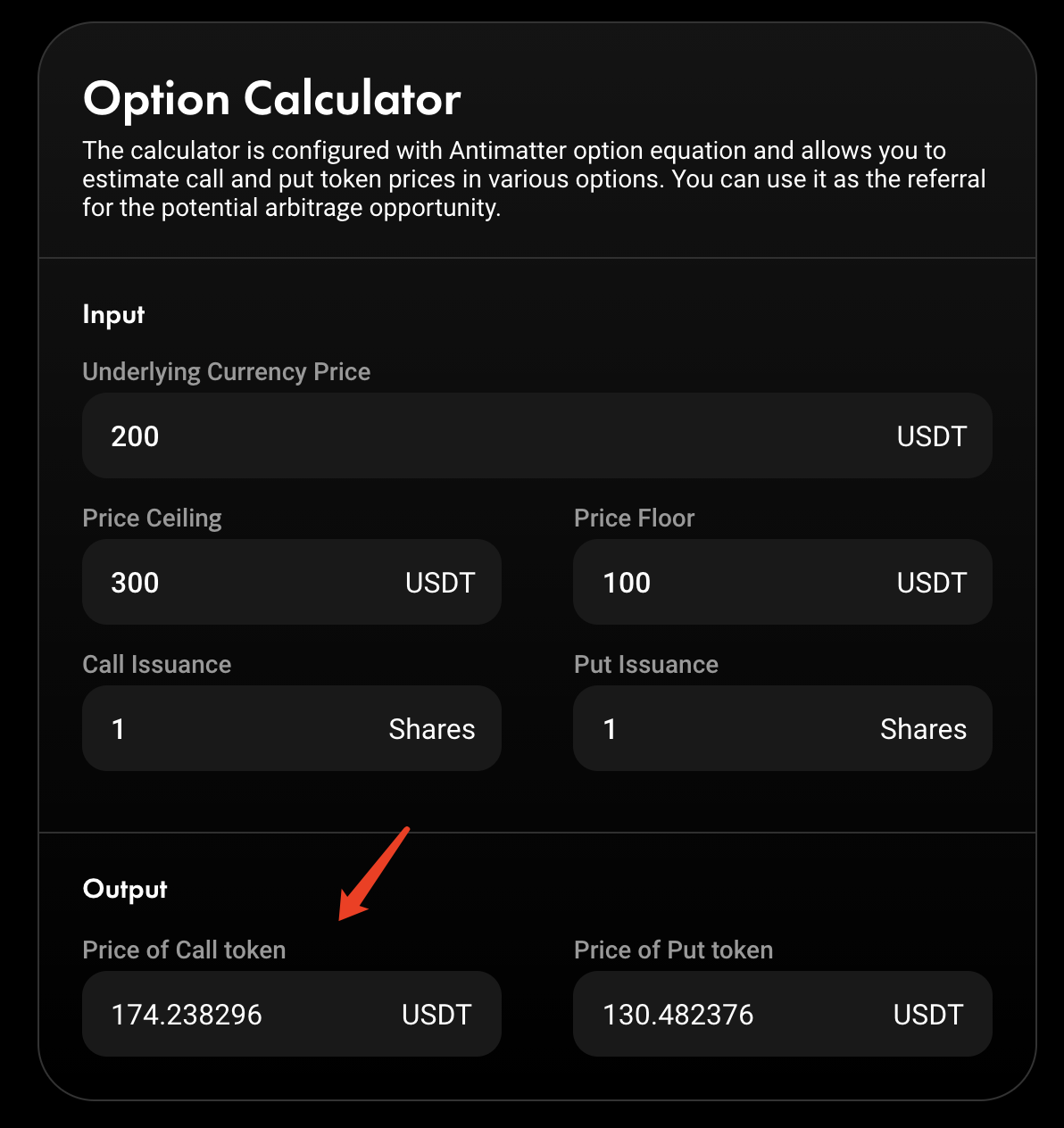
When all input parameters are correct, the Price of Bull Token and Bear Token will be displayed in the buttom Output section. With the calculator you can calculate the Token price of the Option you want to trade in advance.
## **Statistics Tool**
In the Tools you can also find the statistics,showing the platform's current total trading volume,total value locked,the number of asset types supported and available chains.

# Account System
This account system is designed for users to easily manage the options you have created and view your trading history.
1\. Click on the green ball logo right beside your wallet address on the upper right corner of the page to open the list of account features.

2\. In “My Position”, You can see your current holdings of bear and bull tokens, listing out the types, amounts and contract addresses.

3\. In “My Creation”, you can see all the Options you have created.

Click on “Trade” can go directly to this option trading interface.
4\. In "My Transaction",you can view all your transaction records.

5\. You can access your wallet account by clicking on your wallet address on the upper right corner of the page. Here you can change your connected wallet.


# Getting Started - Antimatter Structured
## Getting Started
### How to Deposit and Withdraw your Assets
{% hint style="info" %}
Antimatter Dual Investment is currently only available on Binance Smart Chain, therefore you can only deposit BTCB and USDT from Binance Smart Chain
{% endhint %}
1\. Go to
2\. Connect your Binance Smart Chain wallet
3\. Navigate to your Account page

4\. Press the "Deposit/Withdraw" button for your desired currency (You need BTC for "upward-exercise" and USDT for "downward-exercise" product)

5\. Enter your desired amount and confirm the transaction in your wallet. You might have to approve the currency first
# Dual Investment Subscription
Dual Investment User Guide
Antimatter Dual Investment is an advanced options derivative based on a decentralised protocol. The product has a "market-neutral, returns guaranteed" feature, where the yield is clear and fixed at the time of purchase, while the settlement currency is uncertain. At maturity, the settlement currency depends on the outcome of the settlement price at maturity compared to the strike price.
{% embed url="" %}
Dual Investment - Subscription Guide
{% endembed %}
### How to Subscribe to Antimatter Dual Investment
1\. [Deposit](/user-guide/getting-started-antimatter-structured) the needed currency
2\. Select a Dual Investment of your choice and click on "Subscribe now"

3\. Make sure you understand the possible outcomes and read the Risk Statement
4\. Input the amount you want to invest and press the "Subscribe" button

5\. After confirmation you can view your position on your Account page under the "Position" tab
{% hint style="warning" %}
Please note that Dual Investment cannot be redeemed early.
{% endhint %}
### How to Claim a Delivered Product
1\. Navigate to your Account page and open the "Position" tab

2\. Press on the "Claim" button and confirm the transaction in your wallet
3\. Share your returns on Social Media

## Referral Program
To encourage our users to recommend our product to others we implemented a simple referral system.
* Users are charged a 3% fee on their profit, when claiming their returns.
* If the receiving Account is a referred user, the **referrer** gets \~17% (0.5% of profit) of the 3% fee as a reward and the remaining 2.5% stay on the platform.
# Recurring Strategy Subscription
Recurring Strategy User Guide
Recurring Strategy generates yield by running an automated BTC options strategy. The strategy reinvests the earnings earned back into the strategy, effectively increasing the saver's returns over time.
## How to Subscribe to Recurring Strategy
1\. [Deposit](/user-guide/getting-started-antimatter-structured) the needed currency
2\. Navigate to Invest > Recurring Strategy
3\. Select a Recurring Strategy of your choice and click on "Add"

4\. Make sure you understand the possible outcomes and read the Risk Statement
5\. Input the amount you want to invest and press the "Invest" button

# Defi Option Vault Subscription
Defi Option Vault User Guide
Defi Option Vaults (DOV) generate yield by running an automated options strategy. The recurring strategy reinvests the earnings earned back into the strategy, effectively increasing the saver's returns over time.
## How to Deposit into a Vault
1\. Visit [dov.antimatter.finance](https://dov.antimatter.finance/#/defi)
2\. **Select a vault** you want to deposit assets into and **click on Add**.

3\. **Connect your wallet** and make sure you are **on the correct network**
4\. Input the amount you want to invest. The deposit currency depends on the underlying asset and options strategy

5\. **Click on Invest** and **confirm the transaction** in your wallet.
6\. After confirmation you can view your position under the "Position" tab
{% hint style="info" %}
Your deposit will be locked in once a new cycle starts (Friday 8AM UTC). Before the cycle starts, you have the option to instantly withdraw your funds.
{% endhint %}
{% hint style="warning" %}
Please note that once locked in, the investment cannot be redeemed early. You have to initiate withdrawal before the next cycle starts.
{% endhint %}
# Defi Option Vault Withdrawal
Defi Option Vault User Guide
## How to Withdraw from an Defi Option Vault (DOV)
There are two options for withdrawal.
1. Instant Withdrawal
2. Standard Withdrawal
### Instant Withdrawal
Instant withdrawals are only available for funds that have been deposited but not yet deployed in the Defi Option Vault. Because these funds haven't been deployed they can be withdrawn immediately.
{% hint style="info" %}
Deployment happens on a weekly basis every Friday 8AM UTC.
{% endhint %}

1\. Input the amount you want to redeem and click on **Instant Withdraw.**
2\. Confirm the transaction in your wallet
### Standard Withdrawal
Standard withdrawals are for funds that have been deployed in the vault's weekly strategy and involve a 2-step withdrawal process:
Step 1: User submits the amount to be withdrawn
Step 2: After the investment expires, the actual withdrawal will be completed, and the withdrawal amount includes the income.

1\. Input the amount you want to redeem and click on **Initiate Withdrawal.**
2\. Confirm the transaction in your wallet
{% hint style="info" %}
Once a cycle concludes the withdrawn amount will be transfered to your wallet
{% endhint %}
# Decision Guide for Dual Investment
{% hint style="warning" %}
**Disclaimer:** This Guide is **not financial advice** and is not supposed to make decisions for you but is intended to make it easier to understand what Dual Investment product might be suited for you.
{% endhint %}
**1.** First, you need to decide if you want to invest into a BTC product or any of the available altcoins. They serve as Underlying Asset for your investment, which means that your return depends on the price action of this asset. Generally said altcoins are more volatile than BTC but APY rates and available products are similar.
**2.** The second and arguably most important thing you need to decide on is the time frame you are considering for your investment. Currently you can choose between 1 day, 7 days and 14 days.
It is important, because Dual Investment is a product that can not be canceled during subscription and the outcome entirely depends on the Settlement Price on the Delivery Date. What happens during the subscription does not affect the outcome.
**3.** You need to decide if you want to subscribe to Upward Exercise or Downward Exercise. The following is a simplification, but generally:
Bullish -> Downward Exercise
Bearish -> Upward Exercise
This might sound counterintuitive, but it becomes clearer, when you understand that an execution of a product is negative for you in most cases. It means that your investment gets exchanged to the alternative currency (e.g. USDT for BTC Upward Exercise).
The optimal outcome is to be just below (upward exercise) or above (downward exercise) the Strike Price, so that the product is not exercised, and you get your deposit + yield in the Deposit Currency. Note that in the case of execution, you still get yield.
With Dual Investment you are not exposed to direct market volatility, but are still exposed to big market shifts. Keep in mind that this also largely depends on the chosen time frame.
Additional resources that might help understanding the concept:
* [Dual Investment - User Guide Video](https://www.youtube.com/watch?v=txyykFe0BIM)
* [Getting Started](/antimatter-structured-product/dual-investment)
# Contracts
# GitHub
GitHub Repository
{% embed url="" %}
Perpetual Option Contract:
{% embed url="" %}
# Auditing report
{% embed url="" %}
# Token Utility
The system needs an utility token to power the fee system and service provision of the system, incentivizing further use of the protocol. In addition, introducing tokens lowers the effective carry cost of conducting platform transactions and hence accelerates the adoption of productive platforms. Following from this, the native digital cryptographically-secured fungible token of Antimatter (**MATTER**) is a transferable representation of attributed governance and utility functions specified in the protocol/code of Antimatter, and which is designed to be used solely as an interoperable utility token on the platform.
In order to promote decentralised community governance for the network, MATTER would allow holders to create and vote on on-chain governance proposals to determine future features and/or parameters of Antimatter, with voting weight calculated in proportion to the tokens staked (the right to vote is restricted solely to voting on features of Antimatter; it does not entitle MATTER holders to vote on the operation and management of the Company, its affiliates, or their assets or the disposition of such assets to token holders, or select the board of directors of these entities, or determine the development direction of these entities, does not constitute any equity interest in any of these entities or any collective investment scheme; the arrangement is not intended to be any form of joint venture or partnership). The governance rule is as follows:
MATTER is a functional utility token which will be used as the medium of exchange between participants on Antimatter in a decentralised manner. The goal of introducing MATTER is to provide a convenient and secure mode of payment and settlement between participants who interact within the ecosystem on Antimatter, and it is not, and not intended to be, a medium of exchange accepted by the public (or a section of the public) as payment for goods or services or for the discharge of a debt; nor is it designed or intended to be used by any person as payment for any goods or services whatsoever that are not exclusively provided by the issuer. MATTER does not in any way represent any shareholding, participation, right, title, or interest in the Company, the Distributor, their respective affiliates, or any other company, enterprise or undertaking, nor will MATTER entitle token holders to any promise of fees, dividends, revenue, profits or investment returns, and are not intended to constitute securities in Singapore or any relevant jurisdiction. MATTER may only be utilised on Antimatter, and ownership of MATTER carries no rights, express or implied, other than the right to use MATTER as a means to enable usage of and interaction within Antimatter.
MATTER also provides the economic incentives which will be distributed to encourage users to contribute to and participate in the ecosystem on Antimatter, thereby creating a mutually beneficial system where every participant is fairly compensated for its efforts. MATTER is an integral and indispensable part of Antimatter, because without MATTER, there would be no incentive for users to expend resources to participate in activities or provide services for the benefit of the entire ecosystem on Antimatter. Given that additional MATTER will be awarded to a user based only on its actual usage, activity and contribution on Antimatter and/or proportionate to the frequency and volume of transactions, users of Antimatter and/or holders of MATTER which did not actively participate will not receive any MATTER incentives.
As the native platform currency, traders can use MATTER to pay protocol fees , including option generation and redemption fees and protocol transaction fees. In the Antimatter NFT, matter is used as the payment currency for NFT transactions and creators reward claims. MATTER is used as a governance token for protocol DAO management.
The design principle of the platform is to distribute MATTER incentives for ecosystem contributions, so it can be obtained by participating in the project’s governance, as well as participating in various beneficial usage activities on the platform such as creation and redemption of options, and as well as liquidity provision.
We develop a hybrid staking model that facilitate option market expansion and community satisfaction. We promote two parallel staking systems that fulfill the needs of both market creators and individuals.
First, we invent an adoption model with token integration. Platforms create value by incentivizing market creators to create option markets on blockchain and creating benefits to both creators and traders. With a mechanism that utilises staking to encourage users to provide services, tokens are staked based on market creators demand. Second, we invent a staking model that allocates benefits generated from the fees operation to incentivise active token holders which actually participate in the network growth and adoption.
{% hint style="info" %}
> More utility will be added along the road. Token economics is a dynamic subject that evolves with the project development and product usage.
> {% endhint %}
# Token Information
## Token Information
{% embed url="" %}
{% embed url="" %}
# Token Bridge
## Arbitrum Bridge
You can use Arbitrum official bridge to cross chain your MATTER from Ethereum to Arbitrum.
Access through:
Guide: